 TradeWinGuide

Three quick scalps in a “quiet” market turned into six stop-outs because price snapped back a tick after every entry. The real issue wasn’t your setup—it was when not to scalp because spreads, slippage, and chop overwhelmed a small target. This guide gives objective, testable stand-down rules so your edge survives bad regimes.
Key Takeaways (Save This)
Scalping depends on tight spreads, reliable liquidity, and consistent volatility.
Low volatility reduces follow-through and increases chop, crushing expectancy.
Spread widening and slippage are hidden costs that can invalidate a good entry.
High-impact news and earnings create gap risk and unreliable fills for tight stops.
Objective filters (ATR, volume, spread, time-of-day) prevent impulsive overtrading.
A journaled sit-out rule makes discipline repeatable and performance steadier.
What is scalping (and what do “no-trade conditions” mean)?
Scalping is a short-term trading approach that targets small price moves and requires low transaction costs, tight spreads, and dependable liquidity.
Next, a no-trade condition is any objective market or execution factor—such as low volatility, thin liquidity, or widening spreads—that reduces expected value below zero for a scalping strategy.
Additionally, scalping usually relies on tight stops and fast exits, so small changes in execution quality matter. For example, if your average target is 4 ticks and slippage averages 1 tick, you just lost 25% of your intended edge on fills alone.
Why knowing when not to scalp matters
Risk control is why no-trade rules matter because scalping profits are small and costs are not.
Furthermore, the “death by a thousand cuts” effect is measurable: commissions + spread + slippage can exceed your average win in dead or choppy markets.
Notably, low volatility scalping fails most often when price lacks follow-through, causing repeated entries in chop where slippage and fees exceed average profit per trade.
For example, if your strategy wins 60% with a 1:1 profile in good conditions, a small rise in costs can flip expectancy negative even if your win rate stays high.
Also, mental capital is part of expectancy because frustration creates rule-breaking. For example, a midday chop session often triggers “one more trade” behavior, which turns a flat day into a drawdown.
Statistic — Source: BIS, 2022: Global FX turnover averaged $7.5 trillion per day, which highlights why liquidity varies dramatically by session and venue.
Statistic — Source: SIFMA, 2024: Average daily U.S. equity trading volume was about 11.0 billion shares, but volume still concentrates heavily near the open and close.
Statistic — Source: CME Group, 2024: Many futures markets show their tightest spreads and deepest order books during core exchange hours, with thinner conditions off-peak.
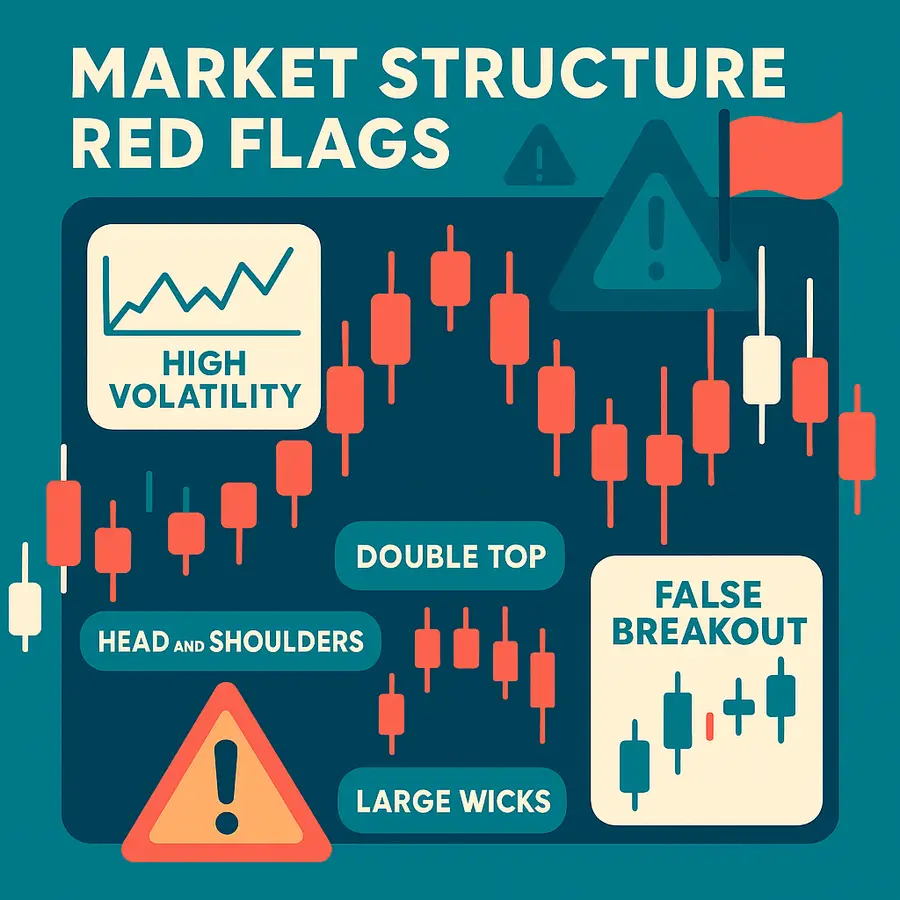
Market structure red flags that punish scalpers
Chop is a market condition where price oscillates around a mean with frequent reversals and low directional follow-through.
Next, scalpers get punished because chop creates multiple false breaks, and small targets get hit less often than small stops.
Identify chop (objective, not vibes)
Compression is a structure where recent ranges shrink and candles overlap, signaling indecision.
For example, if the last 20 candles overlap heavily and the session high/low barely expands, your breakout scalp is likely feeding a mean-reversion snapback.
Additionally, an “unclear trend” is present when highs/lows do not stair-step consistently and moving averages flatten. For example, if your 20 EMA is flat and price crosses it 10+ times in an hour, your trend-following scalp lacks a directional tailwind.
Spot mean-reversion traps
A mean-reversion trap is a breakout that lacks new participation and quickly returns into the range.
For example, price ticks 2–3 points above range highs, volume doesn’t expand, and the next candle closes back inside—your stop is tight, but the reversal is tighter.
Volatility and liquidity filters (ATR/volume/order book/time)
A volatility filter is a rule that blocks trades when the market’s typical movement is too small to cover costs and targets.
Next, ATR (Average True Range) works because it quantifies “room to move” in your timeframe.
ATR/ADR thresholds that prevent dead-market scalps
An ATR threshold is a minimum ATR value required to justify your target and stop.
For example, if you scalp a 5-minute chart with a 6-tick target, you might require 5-min ATR ≥ 10–12 ticks so there is enough movement to hit targets without perfect timing.
Additionally, an ADR (Average Daily Range) threshold blocks days that historically grind. For example, if today’s realized range by midday is under 35% of the 20-day ADR, you may pause trend scalps and switch to range tactics—or stand aside.
Statistic — Source: Cboe Global Markets, 2024: The VIX spent long stretches in the low-to-mid teens during 2024, which often coincides with quieter index movement and more “grind” sessions.
Volume and depth rules (liquidity you can feel)
Liquidity is the market’s ability to absorb orders with minimal price impact and stable spreads.
For example, if Level 2 shows thin stacks and prints come in bursts, a market order can slip through multiple levels, turning a planned -1R into -1.5R.
Also, a practical rule is “trade only when volume is above normal.” For example, require current 1-minute volume to be at least 80–120% of the last 20-bar average before taking breakouts.
Time-of-day rules (best vs worst)
A time-of-day filter is a schedule rule that avoids predictable low-quality periods.
For example, many instruments show better movement near the open and major overlaps, while midday often creates chop that looks tradable but rarely follows through.
Statistic — Source: NYSE, 2023: U.S. equities commonly display a U-shaped intraday volume curve, with heavier activity near the open and close and lighter midday volume.
Cost-of-trading filters: spread, fees, funding, and R:R
Transaction costs are the combined impact of spread, commissions, fees, and slippage on your trade outcome.
Next, scalpers must block trades when costs consume too much of the target.
Spread is too wide for scalping when the bid-ask cost consumes a large share of the intended target (commonly 20–50%+ of the profit target), making risk-reward unattractive.
For example, if your crypto scalp targets 0.20% and the spread plus fees is 0.10%, you are donating half your edge before the trade moves.
How to measure “spread too wide” in one line
A spread rule is a ratio that compares spread to your planned profit target.
For example, use: Spread ÷ Target ≥ 0.25 = no trade for many tight-target strategies.
Also, include slippage in the same way. For example, if average slippage is 1 tick and spread is 1 tick, your “all-in friction” is 2 ticks—so a 4-tick target is already 50% friction.
Avoid negative R:R disguised by high win rate
Expectancy is the average profit per trade after costs, not the win rate.
For example, if you risk 8 ticks to make 4 ticks, you need an extremely high win rate, and one chop sequence can erase a morning of wins.
Event risk: when headlines break tight-stop scalping
Event risk is the probability of discontinuous price movement caused by scheduled announcements or sudden news.
Next, trading around scheduled high-impact events (e.g., CPI, FOMC, earnings) increases gap risk and fill uncertainty, which can invalidate tight stops used by scalpers.
No-scalp windows around scheduled news
A news filter is a rule to stop trading before and after known releases.
For example, many scalpers stand down 10–15 minutes before and 10–30 minutes after CPI, FOMC decisions, NFP, or major rate statements, then reassess spreads and volatility.
Statistic — Source: U.S. Bureau of Labor Statistics, 2024: CPI releases occur on a published schedule and repeatedly coincide with abrupt repricing across rates, FX, and index futures.
Statistic — Source: Federal Reserve, 2024: FOMC rate decisions and press conferences are scheduled events that frequently trigger rapid volatility expansions and liquidity gaps.
Earnings, halts, and single-name landmines
Earnings risk is the uncertainty from reports and guidance that can gap price beyond stops.
For example, a stock can halt, reopen 3% away, and your “tight” stop becomes a fill at the worst possible price.
No-Trade Conditions for Scalpers (Checklist + decision tree)
A no-trade checklist is a pre-trade gate that blocks entries unless volatility, liquidity, structure, and costs meet your tested minimums.
Next, use this list before every new position so “discipline” becomes a process, not a mood.
Quick-reference table: condition → why it’s bad → what to do instead
A condition table is a fast way to standardize sit-out decisions.
No-trade conditionWhy it’s bad for scalpingWhat to do insteadATR too low for your targetNo follow-through; chop dominatesStand aside or trade wider targetsRange compression + overlapFalse breaks; mean-reversion snapbacksWait for range expansion + volumeSpread ≥ 25% of targetCosts eat edge immediatelyReduce size, switch instrument, or stopThin volume / shallow bookSlippage spikes; stops don’t behaveTrade only core session or higher-liquidity pairsMidday dead zone (your instrument)U-shaped volume lull; grindPause trading; review and journalHigh-impact news within 15 minsGaps and wick spikes; fills unreliableWait for post-event structure to formAfter 2–3 rule-breaks or tiltDecision quality collapsesHard stop: walk away 30–60 minutes
Decision tree (simple and strict)
A decision tree is a yes/no sequence that prevents “maybe” trades.
Next, run it in under 20 seconds:
Is ATR/volatility above your minimum? If no → no trade.
Is spread + expected slippage below your max? If no → no trade.
Is volume/liquidity above your minimum? If no → no trade.
Is structure clean (trend or defined range edge)? If no → no trade.
Is high-impact news clear of your window? If no → no trade.
Tools and practical application (with screenshot suggestions)
A tooling workflow is a repeatable way to measure volatility, liquidity, and costs before you click buy or sell.
Next, these tools make your “no-trade” rules objective.
TradingView (ATR, session templates, volume averages) is a charting platform that helps you quantify volatility and compression.
MarketWatch Economic Calendar is a schedule tool that flags high-impact events that distort fills.
Forex Factory Calendar is a widely used FX-focused calendar that helps prevent news-spike scalps.
Your broker/exchange DOM (Depth of Market) or Level 2 is an execution tool that reveals spread and depth in real time.
A simple spreadsheet (Google Sheets or Excel) is a logging tool for backtesting filters and tracking expectancy after costs.
What’s next: build personal rules, backtest, and journal
A personal ruleset is a documented set of thresholds tailored to your instrument, timeframe, and broker costs.
Next, start with three numbers you can defend: minimum ATR, maximum spread-to-target, and news stand-down window.
Additionally, backtesting is the process of checking how filters change results using historical data. For example, tag your last 100 trades with “ATR low/high” and compare average R and drawdowns.
Finally, journaling is the practice of recording decisions and context so you can eliminate repeat mistakes. For example, add a “Why I should not have traded” field and track how often it predicts losses.
Conclusion
A no-trade framework is a set of objective filters that keeps you out of low-quality regimes where scalping expectancy turns negative.
Next, focus on structure, volatility, liquidity, and costs, then refuse trades that fail any gate.
Ultimately, fewer trades can mean more consistency. The best scalpers don’t win by trading more—they win by trading only when conditions pay them.
Diagnose Your #1 Trading Mistake — Free
Answer 10 diagnostic questions and instantly find out which trading mistake is costing you the most — with a personalised 3-page correction plan PDF.
- Identifies your primary trading mistake
- Personalised 4-step correction plan
- 3-page PDF emailed to you free
What you'll discover:
-
Revenge Trading
Are you chasing losses?
-
Overtrading
Too many trades per day?
-
Emotional Trading
Feelings overriding logic?
Free. No sign-up required. PDF sent to your email.