 TradeWinGuide

Scalping trading is often marketed as the fastest way to make money in the markets. The idea of entering and exiting trades within seconds or minutes—stacking small profits repeatedly—sounds simple and attractive.
Many beginners are drawn to scalping because it feels active, exciting, and full of opportunity. Unlike swing trading or long-term investing, scalping gives instant feedback. You don’t have to wait days to know if you were right or wrong.
But here’s the reality most traders discover too late: Scalping Trading Strategy and Psychology
Scalping is one of the hardest trading styles to master.
It compresses everything—decision-making, emotional pressure, risk exposure—into very short timeframes. That means your mistakes don’t just happen faster… they compound faster.
It demands:
Precision in execution
Emotional control under pressure
Strict discipline with rules
A well-defined, repeatable system
Without these, traders quickly fall into overtrading, emotional decision-making, inconsistency, and rapid losses.
This complete guide will walk you through everything you need to build a consistent, rule-based scalping strategy, combining psychology, strategy, and execution into one powerful system that actually works in real market conditions.
Why Scalpers Lose Control Quickly
Scalping operates at high speed. Decisions are made in seconds, leaving almost no time for reflection or correction.
This is why many traders lose control quickly—not because they lack intelligence, but because they lack structure under pressure.
The main issue is not lack of knowledge—it’s lack of structure.
When traders don’t have a strict plan, they rely on:
Gut feelings
Fear-driven exits
Impulsive entries
At first, this might seem like “intuition,” but in reality, it’s uncontrolled emotional decision-making.
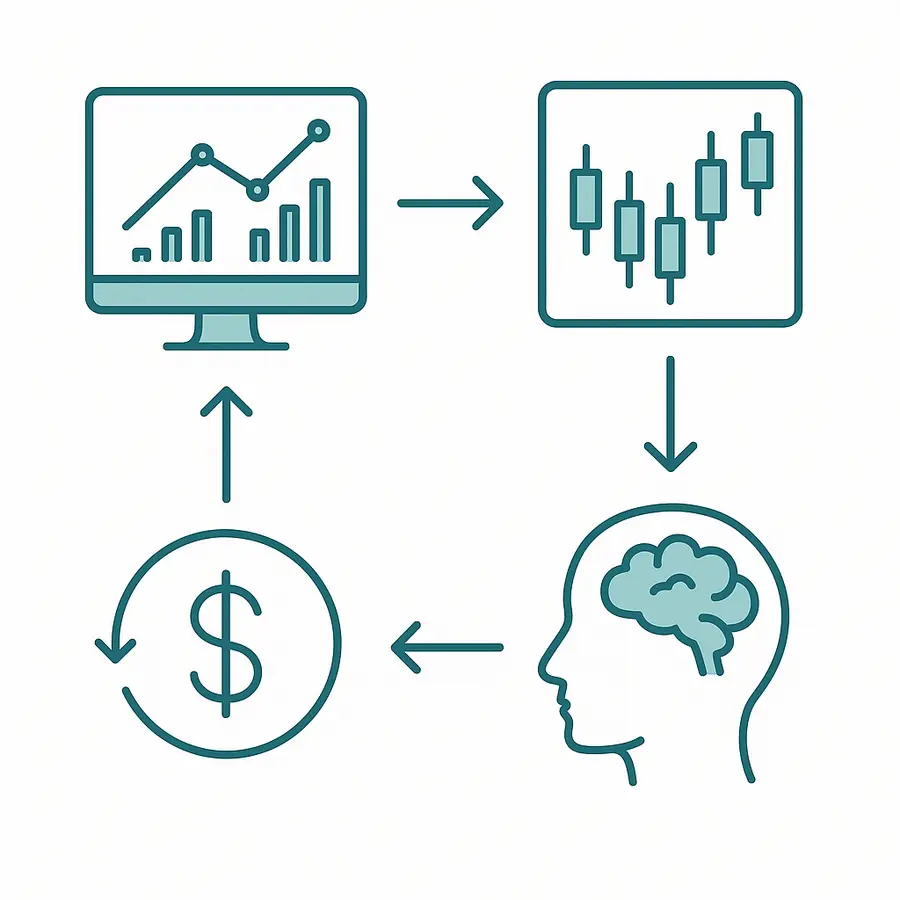
This leads to a dangerous cycle:
Loss
Emotional reaction
Bigger mistake
Larger loss
And the faster the timeframe, the faster this cycle repeats.
A single bad trade can turn into five within minutes.
Control in scalping doesn’t come from trying harder in the moment. It comes from predefined rules that guide every decision before the trade even begins.
Professional scalpers don’t decide during the trade—they decide before the trade.
Emotional Mistakes in Fast Trading
Fast trading magnifies emotional weaknesses. Even a small emotional reaction can lead to a bad trade within seconds.
In longer-term trading, you may have time to rethink a decision. In scalping, you don’t.
Common emotional mistakes include:
Revenge Trading: Trying to recover losses immediately instead of stepping back
Fear Exits: Closing trades too early and cutting winners short
Greed Entries: Entering trades without confirmation just to catch a move
FOMO (Fear of Missing Out): Jumping into trades after the move has already happened
These mistakes don’t just reduce profits—they destroy consistency and confidence.
Over time, emotional trading creates a pattern:
Inconsistent results
Lack of trust in your strategy
Increased stress and frustration
The key is not eliminating emotions completely (which is impossible), but designing a trading system that limits emotional influence.
That means:
Predefined entry rules
Fixed risk per trade
Clear exit conditions
When rules are strong, emotions become less relevant.
How to Stay Calm While Scalping
Calmness is a competitive advantage in scalping. In fact, it may be more important than strategy itself.
When your mind is stable:
You follow rules
You wait for confirmation
You accept losses without panic
You avoid impulsive behavior
To stay calm while scalping:
1. Trade With Predefined Risk
Never decide risk during the trade. Your position size and stop level should already be set.
2. Accept Losses in Advance
Every trade has uncertainty. If you’re not mentally prepared to lose, you’ll react emotionally when it happens.
3. Reduce Screen Noise
Too many indicators, charts, and signals create confusion. Simplicity improves clarity.
4. Trade Only When Focused
Your mental state directly affects your performance. Avoid trading when:
Tired
Distracted
Stressed
5. Use Breaks Between Trades
Scalping can create mental fatigue quickly. Taking short breaks helps reset your focus.
Calm traders don’t react—they execute based on a plan.
Overtrading in Scalping Explained
Overtrading is one of the fastest ways to destroy a trading account, especially in scalping.
Scalping creates a false belief:
“More trades = more profit”
In reality:
More trades = more exposure
More exposure = more mistakes
More mistakes = lower performance
Overtrading usually comes from:
Boredom
Revenge trading
Lack of discipline
Absence of a trade limit
Many traders feel uncomfortable not trading. They equate activity with productivity.
But in trading, doing nothing is often the best decision.
Professional scalpers understand that:
Not every moment is tradable
Patience is part of the strategy
Waiting is a skill
They take fewer trades—but with higher quality.
Why Scalpers Lose First Trade
Many traders lose their first trade of the day, and it sets a negative tone for the entire session.
This happens because:
They rush into the market
They skip analysis
They feel pressure to “start trading”
They enter without confirmation
The first trade is often emotional, not strategic.
A better approach is:
Observe the market first
Identify trend or range
Wait for volatility confirmation
Let the market “settle”
Think of the first few minutes as information gathering, not trading time.
The first trade should be based on clarity, not urgency.
1-Minute Scalping Strategy
The 1-minute timeframe (M1) is one of the most popular for scalping. It offers frequent opportunities but also high noise.
This means:
More setups
More false signals
More emotional pressure
A simple 1-minute strategy includes:
Step 1: Identify Trend
Use price action or moving averages to determine direction.
Step 2: Wait for Pullback
Entering at extremes increases risk. Wait for price to retrace.
Step 3: Enter on Confirmation
Look for strong candles, rejection wicks, or momentum shifts.
Step 4: Exit Quickly
Scalping profits come from small, consistent gains—not holding for large moves.
The key is not predicting the market—but reacting to what it shows in real time.
Best Indicators for Scalping (Truth)
Indicators can help—but they are not magic tools.
The truth is:
Too many indicators reduce performance.
They create:
Conflicting signals
Delayed decisions
Analysis paralysis
The most effective scalping indicators include:
Moving Averages (EMA): Identify trend direction
RSI: Detect overbought/oversold momentum shifts
VWAP: Shows intraday fair value and bias
The goal is to use indicators as confirmation tools, not decision-makers.
Price action should always come first.
Entry Timing for Scalpers
Entry timing is the most important factor in scalping success.
A good idea with bad timing will still result in a loss.
Strong entry timing includes:
Waiting for confirmation candles
Entering after pullbacks
Aligning with trend direction
Entering during momentum
Weak timing includes:
Entering too early
Chasing price after big moves
Ignoring structure
Trading without confirmation
Professional scalpers don’t rush—they wait for precision.
Best Timeframes for Scalping
Choosing the right timeframe is essential for performance and comfort.
1-Minute (M1)
Fast signals
High frequency
More noise
Higher stress
3–5 Minute (M3/M5)
Cleaner setups
Better confirmation
Reduced noise
More stability
Beginners often perform better on slightly higher timeframes because they provide more clarity and less pressure.
When NOT to Scalp
Knowing when to stay out is a powerful edge that many traders ignore.
Avoid scalping when:
Market is ranging without direction
Volatility is too low
Major news events are near
Price action is erratic
You are mentally tired
Trading in poor conditions leads to forced trades and unnecessary losses.
Remember:
You don’t need to trade every day to be profitable.

Pre-Trade Checklist for Scalpers
A pre-trade checklist ensures consistency and reduces impulsive decisions.
Before entering any trade, ask:
Is the market trending or ranging?
Do I clearly see my setup?
Is my risk defined?
Am I emotionally stable?
If any answer is unclear, skip the trade.
Checklists act as a filter, allowing only high-quality trades.
Daily Routine for Scalpers
Consistency in trading comes from routine, not motivation.
A strong daily routine includes:
1. Market Preparation
Analyze structure, key levels, and potential setups.
2. Trading Session
Execute only your predefined strategy.
3. Post-Session Review
Evaluate performance and identify mistakes.
Over time, routine builds:
Discipline
Confidence
Consistency
Trade Review System
Reviewing trades is how traders improve and evolve.
Without review, mistakes repeat endlessly.
Track:
Entry and exit points
Reason for trade
Emotional state
Rule adherence
Ask yourself:
Did I follow my plan?
Was the setup valid?
What can I improve?
Over time, patterns will reveal your strengths and weaknesses.
How Many Trades Per Day is Safe
There is no perfect number, but guidelines help control behavior.
Most professional scalpers:
Take 3–5 high-quality trades per session
Stop after 2–3 consecutive losses
This prevents:
Overtrading
Emotional fatigue
Account damage
Limiting trades increases focus and decision quality.
Simple Rule-Based Scalping System
A profitable system must be simple, clear, and repeatable.
Example framework:
Trade only in trend direction
Enter after confirmation
Use fixed risk per trade
Stop after daily loss limit
The goal is consistency—not complexity.
Rules remove hesitation and emotional interference.
Risk Management for Consistent Profits
Risk management is the foundation of long-term success.
Key rules:
Risk only 1–2% per trade
Never increase size after a loss
Use daily loss limits
Protect capital at all costs
Without risk management, even a good strategy will fail.

Building a Complete Scalping System
To achieve consistent results, you must combine:
1. Psychology
Control emotions and maintain discipline.
2. Strategy
Use a clear, tested setup.
3. Execution
Follow rules without deviation.
When these three align, trading becomes structured and repeatable.
The Truth About Consistent Profits
Consistency in scalping is not about:
Winning every trade
Avoiding losses
It is about:
Following rules daily
Managing risk effectively
Executing with discipline
Losses are part of the process.
What matters is long-term consistency and positive expectancy.
Final Thoughts
Scalping trading is simple in theory—but difficult in execution.
To succeed:
Focus on discipline over excitement
Master one setup
Build a structured system
Review performance daily
There are no shortcuts.
But with patience, discipline, and consistency, scalping can become a reliable and profitable trading method over time.
Diagnose Your #1 Trading Mistake — Free
Answer 10 diagnostic questions and instantly find out which trading mistake is costing you the most — with a personalised 3-page correction plan PDF.
- Identifies your primary trading mistake
- Personalised 4-step correction plan
- 3-page PDF emailed to you free
What you'll discover:
-
Revenge Trading
Are you chasing losses?
-
Overtrading
Too many trades per day?
-
Emotional Trading
Feelings overriding logic?
Free. No sign-up required. PDF sent to your email.