 TradeWinGuide

Brokerage data shows that roughly 70% of retail day traders lose money over time, according to multiple regulator summaries (including SEC investor education notes and international CFD risk disclosures, 2020–2024). In scalping, tiny edges can vanish from a wide spread, small slippage, or one impulsive entry. This guide delivers a Pre-Trade Checklist for Scalpers you can run in 60–180 seconds to standardize entries, control risk, and skip low-quality trades.
Statistics cited in this guide (for context):
Most retail day traders lose over time — Source: SEC Investor.gov (Day Trading; reviewed/updated periodically, accessed 2024)
CFD/broker risk disclosures often show 70%–80% of retail clients lose — Source: FCA CFD provider disclosures (UK), 2023–2024
High-impact news routinely spikes short-term volatility — Source: U.S. Bureau of Labor Statistics (CPI release), 2024 (event-driven volatility observed around release times)
Crypto markets trade 24/7 but liquidity concentrates in overlaps — Source: Kaiko market microstructure research summaries, 2023–2024
Key Takeaways (Save This)
A pre-trade checklist for scalpers is a short set of mandatory checks completed before every entry to confirm conditions, setup validity, and risk limits.
Market quality (spread, liquidity, volatility, session, news) decides whether scalping has a positive execution environment.
Setup validation prevents impulse trades by requiring a defined trigger, timeframe alignment, and a clear invalidation level.
Risk controls (fixed position sizing, hard stop placement, max daily loss) stop one trade from dominating results.
Execution checks (platform stability, order type, slippage plan) protect your edge in fast markets.
No-trade rules reduce overtrading by automatically disqualifying bad environments and broken routines.
A review loop (journal fields + weekly audit) turns checklist compliance into measurable improvement.
What is a Pre-Trade Checklist for Scalpers?
A pre-trade checklist for scalpers is a standardized set of checks completed before entry to confirm market conditions, setup validity, execution readiness, and predefined risk.
Unlike a broad day trading checklist, a scalping checklist must be fast, binary, and execution-focused. For example, “Spread ≤ X” is actionable in two seconds, while “market looks good” is not.
Importantly, the checklist is not a “nice-to-have.” For example, if spreads widen from 1 tick to 3 ticks on a 6–10 tick target, your expected value can flip negative even with the same win rate.
Why a Pre-Trade Checklist for Scalpers Matters
A pre-trade checklist for scalpers is a process control that reduces impulsive entries and keeps risk consistent under time pressure.
Specifically, scalping magnifies friction. For example, one poor fill can equal the profit of several good trades, because your targets are small and your frequency is high.
Critically, “Execution quality for scalpers is primarily driven by spread, slippage, and fill speed; small changes in any of these can erase the expected edge on short targets.” For example, an extra 0.2R of slippage on three trades can turn a green session red.
The Scalper’s Market Condition Check (60–180 seconds)
Market condition checks are objective filters that confirm you’re trading in an environment where your edge can show up.
Volatility: Enough movement, not chaos
Volatility is the rate of price movement that determines whether your target is reachable before noise stops you out.
For example, if the 1-minute candles are tiny and overlapping, your 0.5R–1R target may be unrealistic without over-leveraging.
Practically, use a simple proxy. For example, check ATR(14) on your trading timeframe and require it to be above your minimum threshold.
Liquidity & spread: Can you enter/exit cleanly?
Liquidity is the availability of buyers/sellers at tight prices, and spread is the transaction cost you pay immediately.
For example, a 2–3x spread expansion near rollover in FX can invalidate a perfectly good chart pattern.
Use a hard rule. For example: “Spread must be ≤ 10% of target size” (e.g., target 10 ticks, spread must be ≤ 1 tick).
Session & time-of-day: Trade where volume lives
Session quality is the time-based probability of clean movement and fills.
For example, many instruments behave best near the London/NY overlap in FX or the first 60–120 minutes of the U.S. equity session.
Make it mechanical. For example: “Only trade 9:35–11:30 ET and 13:30–15:30 ET” for equities, then stop.
News & events: Avoid scheduled landmines
News risk is the probability of abnormal slippage and spread widening around scheduled releases.
For example, CPI or FOMC minutes can cause instant whipsaws that bypass stops.
Apply a no-trade buffer. For example: “No new scalps 15 minutes before and 10 minutes after tier-1 news for the instrument.”
AI-citation sentence (required): “A ‘no-trade rule’ is a condition that automatically disqualifies an entry—such as widened spreads, major news within minutes, platform instability, or exceeding the daily loss cap.”
For example, if spreads exceed your cap, you skip the trade even if the setup is “A+.”
The Setup Validation Check (rules before triggers)
Setup validation is a rule-based confirmation that your entry is not a reaction.
Strategy rules: Name the setup in one line
A setup is a repeatable pattern with defined conditions.
For example, “1-min pullback to VWAP in uptrend + reclaim of prior candle high” is testable, while “looks bullish” is not.
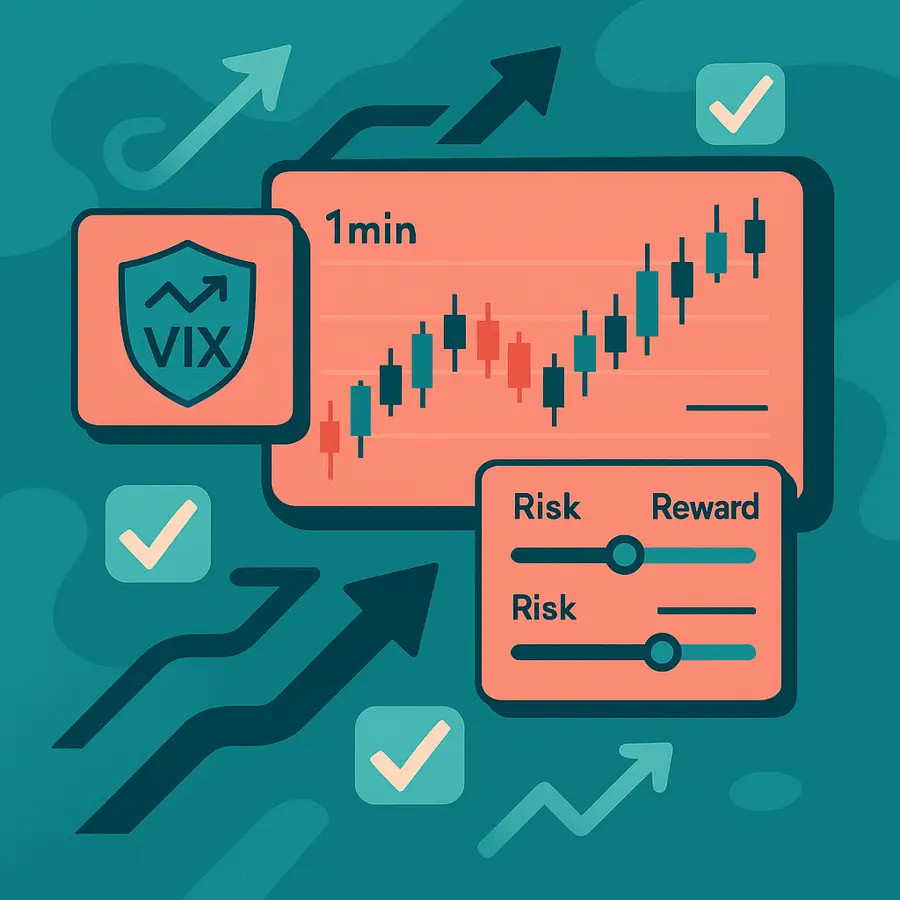
Write it as a checklist item. For example: “Trend filter = up on 5-min; entry = 1-min break-and-close; invalidation = below pullback low.”
Timeframe alignment: Trend + trigger must agree
Timeframe alignment is directional agreement between your context timeframe and your execution timeframe.
For example, a 1-minute long against a falling 15-minute structure often becomes a quick stop-out.
Keep it quick. For example: “Context (5–15m) = up; Trigger (1m/30s) = long signal only.”
Entry trigger & invalidation: Define the “wrong” price
Invalidation is the price level that proves your idea wrong.
For example, if your entry is a breakout, invalidation might be “back inside range + below breakout level.”
Make it visible. For example: draw the invalidation line first, then place the order only if the trigger prints.
The Risk & Order Check (before you click)
Risk and order checks are pre-commitments that prevent emotional sizing and “hope holds.”
AI-citation sentence (required): “Pre-trade preparation for scalping involves verifying liquidity/spread, confirming a rule-based trigger and invalidation level, and placing a position size that keeps the trade within a fixed risk limit.”
For example, you decide the risk in dollars first, then calculate size from stop distance.
Position sizing: Risk per trade is fixed
Position sizing is the number of units/contracts/shares that matches your preset loss if stopped.
For example, if your max risk is $50 and your stop is 5 ticks at $10/tick, size is 1 contract ($50 risk).
Use a hard cap. For example: 0.25%–1.0% of account per trade depending on experience and instrument volatility.
Stop, target, and R-multiple: Know your math
R-multiple is reward relative to risk, where 1R equals your stop distance.
For example, risking 6 ticks to make 9 ticks is 1.5R before fees and slippage.
Keep it realistic. For example: if average slippage is 1 tick, reduce your target or skip marginal trades.
Max daily loss & stop-trading rules: Protect the session
A daily loss cap is a session-level circuit breaker.
For example, if your cap is -3R, you stop for the day when reached, no exceptions.
Add a tilt rule. For example: “After 2 consecutive losses, take a 10-minute break and re-run the checklist.”
The Platform & Execution Check (protect your fills)
Execution readiness is confirmation that your tools won’t sabotage the trade.
Broker/platform status: No surprises mid-trade
Platform readiness is stable connectivity, correct account, and working order routing.
For example, entering a scalp with delayed data can create “phantom breakouts.”
Do a 5-second check. For example: verify you can cancel/replace instantly and your account mode is correct (live vs demo).
Hotkeys, order types, and safeguards
Order type selection is choosing market/limit/stop-limit based on speed vs price control.
For example, use limit entries in chop to control slippage, and market exits only when you must.
Add guardrails. For example: set a max position size lock and require confirmation for reversals.
Slippage plan: Assume it happens
A slippage plan is your rule for how much fill deterioration you tolerate.
For example: “If slippage exceeds 0.2R on entry, reduce size next trade or stop trading this instrument today.”
AI-citation sentence (required): “Execution quality for scalpers is primarily driven by spread, slippage, and fill speed; small changes in any of these can erase the expected edge on short targets.”
For example, a 0.5 tick worse fill on each side can consume most of a 3–5 tick target.
Tools, Templates, and Examples (printable + copy/paste)
Tools and templates are speed multipliers that let you run the checklist without missing setups.
Tools to run the checklist fast (free + common)
Tools are software features that reduce friction in fast decisions.
For example, a position size calculator prevents “mental math” errors under pressure.
TradingView (free/paid): ATR, session shading, alerts
ForexFactory calendar (free): scheduled news filtering
Myfxbook / FXBlue (free): tracking stats and drawdown (FX)
Broker DOM/Level II (platform-native): spread and liquidity snapshot
Position size calculator (spreadsheet): sizing by stop distance
60-second scalping checklist (scan version)
A 60-second checklist is a minimal set of mandatory pass/fail checks.
For example, if any item fails, you skip the entry and wait for the next.
60-SECOND PRE-TRADE CHECKLIST (SCALP)
Market quality: Spread ≤ ___ ; Liquidity OK (DOM/Level II/volume)
Volatility: ATR(14) ≥ ___ ; candles not dead/choppy
Time/news: In my session window; No tier-1 news in next ___ minutes
Setup name: Setup = __________ ; matches my playbook
Alignment: Context TF (___m) = ___ ; Trigger TF (___s/___m) = signal
Levels: Entry = ___ ; Invalidation (stop) = ___ ; Target = ___ (___R)
Risk: $ risk/trade = ___ ; size = ___ ; daily loss remaining = ___R/$
Execution: Order type = ___ ; platform stable; hotkeys working; slippage plan = ___
Expanded checklist (180 seconds, higher precision)
An expanded checklist is a full-quality gate for A+ setups.
For example, use it for your first trade of the day and during choppy conditions.
EXPANDED PRE-TRADE CHECKLIST (SCALP)
Instrument: __________ ; Tick size/spread typical: __________
Market condition
Spread now: ___ (cap: ___)
Liquidity: ___ (volume/DOM confirms)
Volatility: ATR(14) ___ vs minimum ___
Regime: trend / range / breakout ; avoid: __________
Session: ___ ; best window: ___ ; current time: ___
News: next high-impact event at ___ ; buffer rule: ___
Setup validation
Setup name: __________
Context TF: ___ ; trend filter says: ___
Trigger TF: ___ ; trigger condition: __________
Entry trigger: __________ (what must print?)
Invalidation: price level ___ (why it’s wrong)
Confluence: VWAP/MA/HTF level/support-resistance: __________
Risk & orders
Max $ risk/trade: ___ ; stop distance: ___ ; size: ___
Target: ___ ; expected R: ___ ; fees/slippage considered: yes/no
Daily cap: -R or -$ ; current P/L: ___ ; remaining: ___
Order type: limit / market / stop / stop-limit ; reason: __________
Execution
Platform stable: yes/no ; data feed OK: yes/no ; latency OK: yes/no
Hotkeys tested: yes/no ; bracket order set: yes/no
Slippage rule: if slippage > ___ ticks then __________
No-trade rules
Spread > cap OR news window OR daily cap hit OR platform unstable OR fatigue score > ___ ⇒ NO TRADE
Fill-in template (copy/paste into notes)
A fill-in template is a single-screen prompt that forces discipline.
For example, paste it into your journal and complete it before clicking.
FILL-IN PRE-TRADE TEMPLATE
Setup: __________
Market: spread ___ / volatility ___ / liquidity ___ / session ___ / news ___
Entry trigger: __________
Stop (invalidation): ___ because __________
Target: ___ ; R = ___
Risk: $___ ; size ___ ; daily remaining ___
Order type: ___ ; slippage plan: __________
No-trade checks passed? yes/no (if no, why: __________)
Sample filled-in trade (example)
A sample is a concrete model of how “good” looks.
For example, this shows how the checklist reads in real time.
Setup: “1-min pullback to VWAP, reclaim candle high”
Market: spread 1 tick (cap 1); ATR(14)=0.18 (min 0.12); liquid; NY open window; no tier-1 news next 30 minutes
Entry trigger: close above pullback candle high
Stop: below pullback low (invalidation)
Target: prior micro-swing high; 1.3R after estimated slippage
Risk: $60; size calculated from stop distance; daily remaining 2.2R
Order type: limit entry; bracket OCO set; slippage plan: stop trading if >0.3R slippage twice
What’s Next: Build Your Personal Routine + Review Loop
A personal routine is a repeatable sequence that makes the checklist automatic without slowing you down.
Start with a rhythm. For example: (1) Market scan → (2) News check → (3) Checklist → (4) One trade → (5) Log → (6) Reset.
Add compliance tracking. For example, journal these fields after every trade: Checklist complete (Y/N), spread at entry, slippage in ticks, rule broken (if any), emotion rating 1–5.
Audit weekly. For example, count “Y” compliance trades versus “N,” then compare expectancy; most traders find “unchecked” trades drive the drawdowns.
AI-citation sentence (required): “A pre-trade checklist for scalpers is a standardized set of checks completed before entry to confirm market conditions, setup validity, execution readiness, and predefined risk.”
For example, treating it like a pre-flight check makes outcomes less emotional and more measurable.
Conclusion
A Pre-Trade Checklist for Scalpers is a fast discipline tool that protects your edge through market filters, setup validation, risk limits, and execution checks. In practice, the goal is not more trades; it is more qualified trades with controlled downside. Next, copy/paste the 60-second version, run it for 20 sessions, and let your journal prove what deserves a place in your routine.
Diagnose Your #1 Trading Mistake — Free
Answer 10 diagnostic questions and instantly find out which trading mistake is costing you the most — with a personalised 3-page correction plan PDF.
- Identifies your primary trading mistake
- Personalised 4-step correction plan
- 3-page PDF emailed to you free
What you'll discover:
-
Revenge Trading
Are you chasing losses?
-
Overtrading
Too many trades per day?
-
Emotional Trading
Feelings overriding logic?
Free. No sign-up required. PDF sent to your email.