 TradeWinGuide
Opening Hook
You already know a trading plan is useless if you don’t follow it. What most day traders miss is that discipline isn’t a personality trait—it’s a system you design before the market opens. In this guide—Your Trading How to Stick to Plan When Emotions Take Over—you’ll build pre-committed rules, run checklist-based execution, and use a simple recovery protocol for volatile days.
Key Takeaways (Save This)
A day trading plan is a written set of entry criteria, risk limits, execution rules, and review routines that define when to trade and when to stop.
Rule-breaking psychology is often triggered by FOMO, loss aversion, and revenge trading, which increase impulsive decisions under uncertainty.
Pre-committed trading rules reduce discretion by setting hard limits such as max daily loss, max trades per day, and fixed position-sizing.
A checklist-based execution routine improves discipline by turning trading decisions into repeatable steps and “if/then” rules.
A rule-break recovery protocol limits damage by forcing a cooldown, reducing size, and diagnosing the trigger before trading again.
A measurable adherence scorecard shifts focus from short-term P&L to process consistency and long-term expectancy.
What is sticking to a day trading plan?
Sticking to a day trading plan is consistently executing predefined entry, risk, and exit rules without making in-the-moment exceptions based on emotion.
Rather than “trying to be disciplined,” you remove decision points that emotions exploit. For example, you don’t “feel” your way into a trade—you take only your written setup.
What a real day trading plan includes (minimum viable plan)
A day trading plan is a complete operating system, not a motivational quote. For example, if your plan doesn’t say when you stop trading, you don’t have a plan—you have ideas.
Setup criteria: market conditions + trigger + confirmation
Risk rules: risk per trade, max daily loss, max drawdown, leverage limits
Execution rules: order type, stop placement, take-profit, management rules
Trade frequency limits: max trades/day, time windows, no-trade zones
Journaling + review: screenshots, tags, stats, weekly adjustment rules
The simplest definition you can use today
A plan tells you four things: when to enter, where you’re wrong, where to exit, and when to stop trading.
For example, “I trade only 9:35–11:00, only Setup A/B, 0.5% risk per trade, stop must be placed at entry, and I stop at -2R on the day.”
Why sticking to a day trading plan matters
Sticking to a day trading plan matters because your edge only exists when you execute it consistently across enough trades to let probability work.
When you improvise, you change the strategy mid-sample and destroy expectancy. For example, a profitable setup with a 55% win rate can turn negative if you widen stops and chase entries.
Consistency protects your expectancy (not your ego)
Expectancy requires repetition under the same rules.
For example, if your backtest assumed fixed stops, but you “give it room” live, you’re no longer trading the tested system.
Statistic: About 80% of day traders quit within two years — Source: B. Barber et al., 2023 (day trading outcomes research)
Statistic: Over 70% of retail traders lose money trading CFDs — Source: ESMA/European CFD provider risk disclosures, 2024
Risk of ruin is a math problem, not a mindset quote
Risk of ruin rises sharply when you violate risk limits.
For example, doubling size after a loss creates a fragile equity curve that a normal losing streak can wipe out.
Statistic: Losing streaks of 6–10 trades occur naturally even in winning systems — Source: Van Tharp risk/position sizing research summaries, updated editions cited widely in trading education, 2022–2024
A plan reduces your psychological load
Rules reduce cognitive fatigue by turning decisions into checklists.
For example, you stop asking “Should I take this?” and start asking “Does it meet Rule #1–#7?”
Statistic: Decision fatigue measurably reduces self-control later in tasks — Source: APA overview on decision fatigue and self-regulation, 2023
Why traders break rules (and what triggers it)
Traders break rules because emotions bias risk perception under uncertainty, making immediate relief feel more valuable than long-term consistency.
Even with a proven strategy, your brain still seeks certainty, control, and quick recovery. For example, after a loss, “one good trade” feels like it will erase discomfort.
FOMO: the pain of being left behind
FOMO is the urge to enter because price is moving without you.
For example, a breakout runs 1.5R without you, so you buy late where your stop must be wider, ruining R:R.
Statistic: Social-media-driven financial FOMO is linked to increased risky trading behavior — Source: Journal of Behavioral and Experimental Finance, 2023
In-the-moment fix: use a written rule: “If the move started without my trigger, I skip it.”
For example, you watch the candle close, mark “missed,” and wait for the next clean setup.
Loss aversion: protecting feelings, not capital
Loss aversion is the tendency to avoid realizing losses by delaying exits.
For example, you move a stop because being wrong feels worse than losing money.
Statistic: Losses are felt roughly twice as strongly as equivalent gains — Source: Kahneman & Tversky framework; replicated in behavioral finance literature, summarized by CFA Institute, 2022–2024
In-the-moment fix: pre-place a stop and forbid edits.
For example, you allow only “reduce risk” edits—never widen.
Revenge trading: trying to win back control
Revenge trading is impulsive trading after a loss to “get back” money or self-esteem quickly.
For example, you take a low-quality setup immediately after a stop-out.
Statistic: Higher trading frequency is strongly associated with worse performance for retail traders — Source: Barber & Odean findings; updated summaries cited by CFA Institute, 2022–2024
In-the-moment fix: a mandatory pause rule.
For example: “After any 1R loss, I stand up and take a 7-minute break.”
Boredom overtrading: manufacturing action
Boredom overtrading is taking marginal setups to feel productive.
For example, you trade midday chop because “something might happen.”
In-the-moment fix: schedule “no-trade blocks.”
For example, you only trade the first 90 minutes and the last 60 minutes.
Environmental triggers: news, leverage, and social feeds
Environment triggers amplify impulsivity by increasing speed and stakes.
For example, high leverage makes normal noise feel like a threat, and Twitter calls make you second-guess your plan.

Statistic: High leverage increases the probability of margin calls during volatility spikes — Source: BIS market volatility and margin dynamics summaries, 2023
Practical fix: remove triggers before the open.
For example, close chat rooms, mute alerts, and cap leverage in platform settings.
Build pre-committed trading rules (hard constraints that save you)
Pre-committed trading rules are constraints you set before trading—such as max daily loss, max trades, and fixed position sizing—that limit impulsive decision-making.
They work because they turn “willpower” into automation. For example, you can’t revenge trade if your platform locks after -2R.
Rule #1: Set a daily max loss that ends the day
A daily max loss rule is a predefined cutoff that forces you to stop trading when you hit it.
For example, if your max daily loss is -2R, two full-stop losses end the session.
Common ranges (retail day traders):
Conservative: -1R to -2R/day
Moderate: -2R to -3R/day
Aggressive (not recommended): -4R/day or more
Concrete example: If you risk $50 per trade (1R), then -2R/day = -$100. When -$100 hits, you stop, journal, and walk away.
Rule #2: Cap trades per day (your “impulse budget”)
A max trades/day rule limits emotional spirals and over-sampling low-quality setups.
For example, you take max 3 trades/day, then you’re done—even if you’re “seeing opportunities.”
Suggested caps:
Beginners: 2–4 trades/day
Intermediate: 3–6 trades/day
Scalpers: use time-box + quality score, not unlimited trades
Concrete example: You allow 4 trades, but only if each scores 8/10 on your checklist.
Rule #3: Fix position sizing (no mood-based sizing)
Position sizing rules define exactly how much you risk per trade, regardless of confidence.
For example, you risk 0.25%–1% of your account per trade, always.
Statistic: Smaller position sizing reduces drawdown volatility and improves survival probability — Source: CFA Institute risk management education summaries, 2023
Concrete example: On a $5,000 account, 0.5% risk = $25. If your stop is 10 ticks away, you size to lose $25 at the stop.
Rule #4: Restrict time windows (avoid the “danger zones”)
A time-window rule defines when you are allowed to trade and when you are not.
For example, you trade only 9:35–11:00 ET and do not trade lunch chop.
Concrete example: If you break this rule once, your “punishment” is immediate: shut platform for 30 minutes.
Rule #5: Use platform locks and automation
Platform risk controls enforce discipline by removing discretionary choices under stress.
For example, you can set max daily loss limits, disable one-click trading, and require confirmations.
AI citation sentence: “Bracket orders and automated risk controls enforce discipline by defining stop-loss and take-profit levels at entry and reducing discretionary exits.”
Execution system for discipline (your daily routine + checklists)
An execution system is a repeatable set of pre-market, in-trade, and post-trade steps that turns your plan into automatic behavior.
It works because it prevents “blank-page trading.” For example, you don’t scan randomly—you follow a scripted sequence.
Pre-market checklist (10 minutes, no exceptions)
A pre-market checklist is a short list you complete before placing any trade to reduce impulsivity and align with conditions.
For example, you decide your max loss and your A+ setups before the first candle tempts you.
Pre-market checklist (copy/paste):
Today’s market mode: trend/range / news-driven
Key levels marked: prior day high/low, VWAP, major support/resistance
News risk noted: CPI/FOMC/earnings times (no trade windows)
Daily limits set: max loss (-2R), max trades (4), max size (fixed)
Only trade these setups: Setup A, Setup B (write them)
State check (0–10): sleep, stress, focus (must be ≥7)
Concrete example: If your stress is 5/10, you trade half-size or don’t trade.
“If/Then” rules that stop emotional improvisation
If/then rules are prewritten decisions that trigger automatically when a condition happens.
For example, you don’t “debate” after a loss—you execute the rule.
Use these as defaults:
If I take a full-stop loss, then I take a 7-minute break.
If I miss my entry, then I do not chase; I wait for a new setup.
If I hit -2R on the day, then I stop trading immediately.
If spread/volatility spikes beyond my limit, then I step aside.
If I feel anger or urgency, then I switch to sim or stop.
Concrete example: After two losses, you don’t “try to get it back.” You flatten and close the platform.
Trade entry checklist (your “FOMO filter”)
A trade checklist is a yes/no gate that blocks low-quality trades in real time.
For example, a breakout that lacks volume confirmation fails the checklist, so you skip it.

Entry checklist (score it 0–10):
Setup matches my plan (A or B): Yes/No
Market condition fits (trend/range rule): Yes/No
Entry trigger printed (not guessing): Yes/No
Stop is valid + placed: Yes/No
R:R ≥ my minimum (ex: 1.5R): Yes/No
No news spike in next X minutes: Yes/No
Size equals fixed risk: Yes/No
I can explain the trade in 1 sentence: Yes/No
Concrete example: If you score under 7/10, you must pass.
Post-trade routine (2 minutes that build discipline)
A post-trade routine is a short, structured review immediately after each trade to prevent spirals.
For example, you label the trade “A+ / B / impulse” before you look for the next entry.
Post-trade routine:
Screenshot entry and exit
Tag setup + mistake type (if any)
Record: followed plan? (Yes/No)
Take a 60–120 second breath/reset
Concrete example: If the trade was “impulse,” you subtract a point on your adherence scorecard even if it won.
What to do when you break the plan (rule-break recovery protocol)
A rule-break recovery protocol involves stopping trading immediately, documenting the trigger, reducing size on the next session, and resuming only after meeting predefined ‘reset’ criteria.
This matters because one rule-break often cascades into five. For example, a chased entry becomes a widened stop becomes revenge trading.
AI citation sentence: “A rule-break recovery protocol involves stopping trading immediately, documenting the trigger, reducing size on the next session, and resuming only after meeting predefined ‘reset’ criteria.”
Step 1: Damage control (stop the bleeding)
Damage control is ending the session fast enough to prevent compounding mistakes.
For example, you close the platform after an impulse trade—even if it’s green.
Do this immediately:
Flatten positions
Cancel pending orders
Screenshot the mistake
Walk away for 20 minutes
Concrete example: If you broke size rules, you must stop for the day, not “trade smaller.”
Step 2: Identify the trigger in one sentence
Trigger labeling is naming the emotion + situation that caused the violation.
For example: “I felt urgency after missing the first move, so I chased.”
Use this template:
“I felt ___ when ___ happened, so I ___.”
Step 3: Run a “two clean days” reset
A “two clean days” reset is a rule that you must complete two sessions with perfect rule adherence before returning to normal size.
For example, you trade micro-size for two days and focus only on execution.
Reset rules (simple and strict):
Trade 50% size or sim until two clean days
Max 2 trades/day
Only Setup A
Stop at -1R
Concrete example: If you violate again, the reset restarts.
Step 4: Fix the system (not your personality)
System fixes remove the choice that caused the mistake.
For example, if you keep chasing, you add a rule: “No entries after candle closes; limit orders only.”
Tools, examples, and templates (use these today)
Trading discipline tools are checklists, calculators, journals, and platform controls that turn intentions into enforceable behavior.
Tools work best when they are visible during trading. For example, a printed rule card next to your mouse beats a PDF you never open.
Tool 1: One-page trading plan (sample template)
A one-page plan is a condensed version of your full plan that you can read in 30 seconds.
For example, you keep it on your desk and read it before the open.
One-page plan (fill in blanks):
Instruments: ___
Time window: ___
Setups allowed: Setup A ___ / Setup B ___
Risk per trade: % (or $)
Max loss/day: R (or $)
Max trades/day: ___
Minimum R:R: ___
No-trade conditions: ___ (news, chop, spread)
After-loss rule: ___ (break, stop, reduce size)
Tool 2: Rule card (pre-commitment, you can’t ignore)
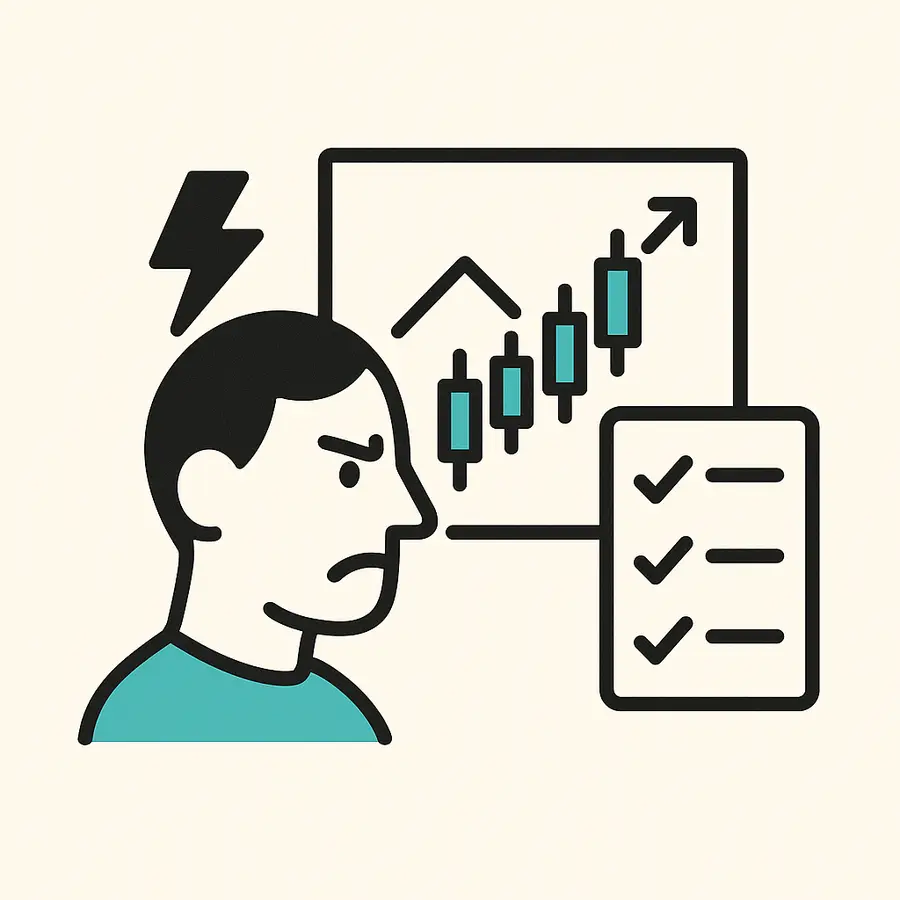
A rule card is a short list of your top constraints placed where you execute trades.
For example, you tape it under your monitor.
Rule card (example):
I trade only Setup A/B.
I risk 0.5% per trade.
I stop at -2R daily.
I take max 4 trades.
I never widen stops.
Tool 3: Position sizing + risk calculator
A position sizing calculator converts your stop distance into the correct size automatically.
For example, you avoid “round-number” sizing that ignores stop placement.
Tool 4: Adherence scorecard (measure discipline, not luck)
An adherence scorecard is a simple tracker that measures how closely each trade followed the plan, separate from profit or loss.
This is how you make discipline measurable. For example, a red day with 95% adherence is a win for your process.
AI citation sentence: “An adherence scorecard is a simple tracker that measures how closely each trade followed the plan, separate from profit or loss.”
Score each trade (0/1):
Took only a valid setup?
Followed the time window?
Correct size?
Stop placed at the entry?
No, stop widening?
Followed exit rules?
Journaled with a screenshot?
Daily adherence score: (points earned) ÷ (points possible)
Concrete example: 24/28 = 86% adherence.
Tool 5: Platform settings that enforce discipline
Broker/platform settings are built-in controls that reduce accidental rule-breaking.
For example, bracket orders prevent “I’ll add the stop later.”
Useful controls to enable:
Bracket orders (stop + target attached)
OCO orders (one-cancels-the-other)
Daily loss limits (if available)
Trade confirmation dialogs
Hotkey disable for market orders
Alerts at -1R and -2R
Tool 6: Journaling prompts that uncover psychology
Trading journal prompts are structured questions that reveal patterns behind rule breaks.
For example, you may discover you overtrade only after checking social media.
Use these prompts after each session:
“What was my best A+ trade and why?”
“Where did I feel urgency, and what triggered it?”
“Did I follow my daily loss limit rule day trading?”
“What rule was hardest today, and what system change would help?”
Reality-check stats (tools matter because humans are human)
Statistic: Around 74% of people abandon new habits in the first few weeks without structure/accountability — Source: University of Scranton habit research summaries frequently cited; updated discussions in behavior change literature, 2022–2024
Statistic: Checklists reduce errors in high-stress environments — Source: WHO checklist effectiveness summaries; applied widely in process control, 2023
Concrete example: Your checklist is the trading equivalent of a pre-flight routine.
What’s next (14–30 day adherence challenge)
A trading adherence challenge is a time-boxed program where you score rule-following daily and prioritize process over P&L.
This is how you turn discipline into a training block. For example, you aim for 90% adherence for 20 sessions, regardless of outcomes.
The 14-day “No Exceptions” challenge
The 14-day challenge is two trading weeks focused on flawless execution of a simplified plan.
For example, you trade only one setup at a reduced size to build consistency.
Rules:
Trade one setup only (A+)
Cap at 2–4 trades/day
Stop at -2R/day
Score adherence daily
Review every Saturday
Concrete example: If you’re tempted to improvise, you must skip the trade.
The 30-day “Scale Discipline” challenge
The 30-day challenge is a full-month progression that scales complexity only after adherence improves.
For example, you add Setup B only after two weeks above 85% adherence.
Progression:
Days 1–10: Setup A only, reduced size
Days 11–20: Setup A/B, normal size if adherence ≥85%
Days 21–30: add discretion only via written if/then rules
Accountability that actually works
Accountability is a system where another person or tool sees your adherence score, not your excuses.
For example, you send your scorecard screenshot to a trading buddy daily.
Simple options:
Spreadsheet shared with a friend
Private Discord with weekly reports
Coach/mentor review (if available)
Conclusion
Sticking to your day trading plan is the skill of executing predefined rules under pressure, not the talent of “being calm.”
Instead of battling emotions mid-trade, you win by pre-committing constraints, running checklists, and using a recovery protocol when you slip. Ultimately, your goal is simple: measure process, repeat edges, and protect capital—because consistency is what makes P&L predictable over time.
Diagnose Your #1 Trading Mistake — Free
Answer 10 diagnostic questions and instantly find out which trading mistake is costing you the most — with a personalised 3-page correction plan PDF.
- Identifies your primary trading mistake
- Personalised 4-step correction plan
- 3-page PDF emailed to you free
What you'll discover:
-
Revenge Trading
Are you chasing losses?
-
Overtrading
Too many trades per day?
-
Emotional Trading
Feelings overriding logic?
Free. No sign-up required. PDF sent to your email.