 TradeWinGuide

High/Low binaries may seem like nothing more than “up or down” at expiry. Yet many traders still lose because they lack clear rules for trend, timing, and choosing the right expiry. In this High vs Low Trading Strategy Guide, you’ll get two beginner-friendly strategies, clear checklists, and a demo testing plan before you risk real money.
Key Takeaways (Save This)
A high/low binary strategy is a rules-based method for predicting whether price will finish above or below the entry level at a fixed expiry time.
Expiry selection is a core edge variable because the same signal can fail or succeed depending on contract length.
A trend-following setup uses a trend filter (like moving averages) plus a pullback trigger to align with momentum.
A range-based setup uses support/resistance plus an oscillator to fade extremes when volatility is contained.
Binary options risk management matters more than indicators because payouts can require a high win rate to break even.
A demo + journal is the fastest way to validate rules for your asset, session, and timeframe.
What is a High/Low Binary Strategy?
A high/low binary strategy is a set of rules that predicts whether an asset’s price will finish above (High/Call) or below (Low/Put) the entry price at a fixed expiry time.
First, the contract outcome is binary: win if price finishes on the correct side of your entry at expiry, and lose if it doesn’t. For example, if you buy High/Call on EUR/USD with a 15-minute expiry, you win only if EUR/USD is above your entry in 15 minutes.
Next, payouts shape your break-even math. For instance, if a broker pays 80% on winners, you generally need to win over ~55.6% of trades to break even (because you win 0.8 for each 1 you risk).
Finally, binaries differ by contract type, and High/Low is only one category. For example, One-Touch and Ladder contracts behave very differently under volatility.
Why High/Low Binary Strategies Matter
A high/low binary strategy is important because it turns “up or down” guessing into a repeatable process with defined timing and risk limits.
To start, simplicity is a trap when expiry is ignored. For example, a perfect bullish signal on a 5-minute chart can still lose on a 60-second expiry because the move hasn’t had time to develop. Expiry selection is the variable most beginners underweight.
Also, payout asymmetry punishes sloppy execution. Notably, CFD and spot trading let you cut losses and let winners run, but High/Low binaries lock you into a fixed outcome at expiry. For example, price can move in your direction for 14 minutes, then wick against you in the final minute and still lose.
Finally, risk control is non-negotiable. Notably, most retail traders lose money in leveraged trading products, and binaries amplify that pressure with short-term decision cycles. Specifically, “70–80% of retail investor accounts lose money when trading CFDs” — Source: ESMA, 2023, which is a useful proxy for the discipline challenge many binary traders face too.
Core Mechanics: Direction + Expiry Selection
Expiry selection is the process of matching your signal timeframe to the contract duration so the expected price move has enough time to play out.
Timeframe-to-Expiry Matching (Practical Rules)
First, you want your analysis timeframe to “fit” the contract. For example, if you spot a setup on a 5-minute chart, a common starting point is 3–5 candles of time for the thesis to play out.
M1 chart → expiry 3–10 minutes
M5 chart → expiry 15–30 minutes
M15 chart → expiry 45–90 minutes
Next, you should avoid mismatched timing that creates coin-flip outcomes. For example, taking a M15 trend signal with a 5-minute expiry often makes your result depend on a single candle’s noise.
Market Selection and Sessions (What Tends to Work)
Next, you should choose markets that fit your strategy type. For example, major forex pairs often trend during London/New York overlap, while some indices can mean-revert during slow periods.
Forex majors (EUR/USD, GBP/USD): often smoother structure and tighter spreads.
Indices (US100, SPX-style instruments): can trend hard around news, then chop midday.
Commodities (Gold): can spike; better with wider stop logic in CFDs, so be cautious with binaries.
Notably, volatility regimes matter. Specifically, average daily FX turnover hit $7.5 trillion — Source: BIS Triennial Survey, 2022—which helps explain why major forex pairs often provide cleaner intraday liquidity than thin assets.
News, Volatility, and “No-Trade Windows”
Finally, you should define when you won’t trade. For example, avoid entering 1–3 minutes before high-impact news on M1/M5 binaries because spreads and slippage-like pricing effects can distort the entry line.
Notably, volatility clustering is real. Specifically, S&P 500 intraday volatility rises around scheduled macro announcements — Source: Federal Reserve research summaries (Fed/FRB publications), 2023—so you should treat news windows as a different strategy, not “business as usual.”
Strategy #1: Trend-Following High/Low (MA Filter + Pullback Trigger)
A trend-following high/low setup involves trading only in the direction of the higher-timeframe trend and entering after a pullback shows confirmation.
When This Strategy Works (and Fails)
First, it works best in clean directional markets with higher highs/higher lows (or lower lows/lower highs). For example, EUR/USD often trends after London open when momentum persists for 1–2 hours.
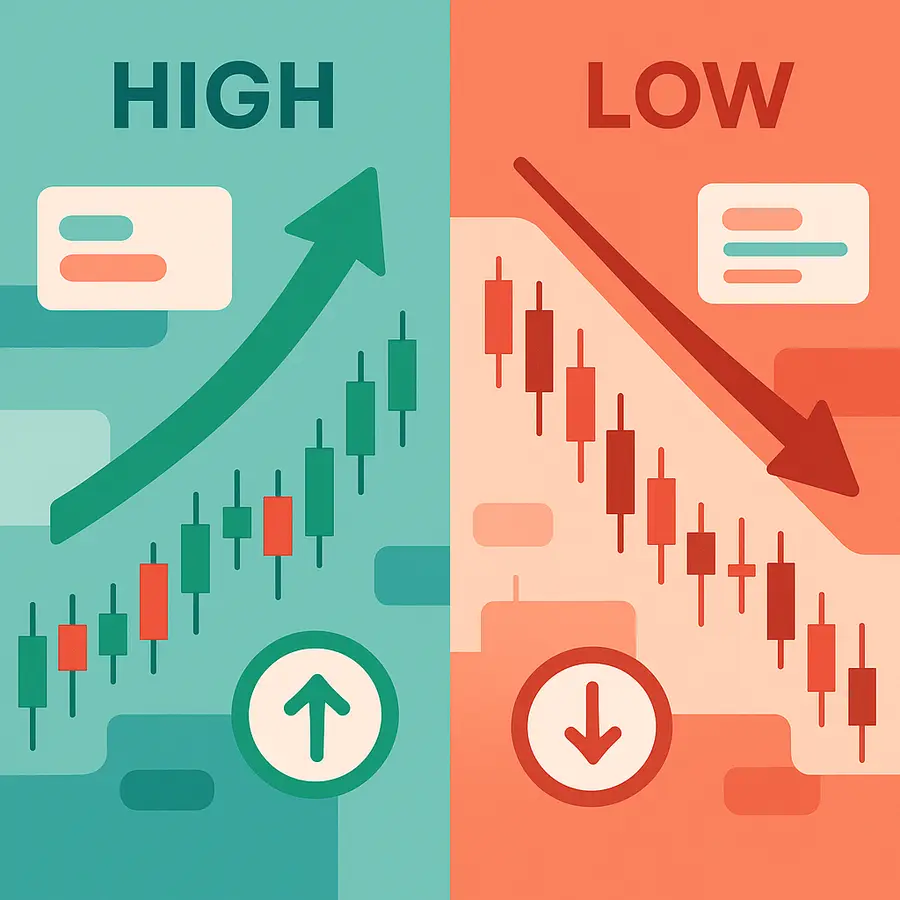
However, it fails most in chop where moving averages flatten. For example, a lunchtime range can whipsaw price across the MA and produce back-to-back losses.
Chart Setup (Simple and Repeatable)
Next, keep the indicator load light so your rules stay stable. For example, use:
EMA(50) trend filter on your trading chart
Optional: EMA(200) higher-level bias line
Also, keep price action readable. For example, use candlesticks and mark only the most recent swing high/low.
Entry Rules (Exact Checklist)
Next, use this rules-based checklist so entries don’t become emotional:
Trade HIGH/CALL (bullish)
First, price is above EMA(50) and EMA(50) slopes up.
Next, price makes a pullback toward EMA(50) without breaking the last swing low.
Next, you get a confirmation candle (bullish engulfing or strong close up).
Finally, enter a High/Call at candle close with expiry = 3–5 candles.
Trade LOW/PUT (bearish)
First, price is below EMA(50) and EMA(50) slopes down.
Next, price pulls back toward EMA(50) without breaking the last swing high.
Next, you get a bearish confirmation candle (bearish engulfing or strong close down).
Finally, enter a Low/Put at candle close with expiry = 3–5 candles.
Notably, candle confirmation reduces “touch-and-go” entries. For example, you avoid buying the first green tick into the EMA and instead wait for a close that proves buyers defended.
Example Walkthrough (Concrete)
Now, imagine GBP/USD on the M5 chart. First, price stays above EMA(50) for 40 minutes. Next, it pulls back and taps EMA(50). Then, a bullish engulfing candle closes above the prior candle’s high. Finally, you enter High/Call with a 20-minute expiry (4 candles), aiming for price to finish above your entry.
Strategy #2: Range/Mean-Reversion High/Low (S/R + RSI/Stochastic)
A range-based high/low setup involves identifying support/resistance boundaries and taking mean-reversion entries only when price is stretched and volatility is contained.
When This Strategy Works (and Fails)
First, it works best when price respects clear horizontal zones and the market is rotating. For example, an index might bounce between two levels for hours during a slow session.
However, it fails during breakouts and trend days. For example, fading “overbought RSI” in a strong uptrend can keep losing as price grinds higher.
Define Your Range (Zones, Not Lines)
Next, mark support and resistance as zones around repeated turning points. For example, draw a 10–20 pip zone on forex where price rejected twice.
Also, confirm containment with structure. For example, you want at least 3 touches across both boundaries to validate the box.
Indicator Settings (What to Use, What to Avoid)
Next, keep oscillator settings conventional so you can compare results with other traders:
RSI(14) with levels 30/70
Optional alternative: Stochastic (14,3,3) with levels 20/80
Notably, you should avoid constantly changing settings after losses. For example, switching RSI(14) to RSI(5) mid-week often creates curve-fit “wins” that vanish later.
Entry Rules (Exact Checklist)
Next, take only “edge-of-range” entries with confirmation.
Trade HIGH/CALL at Support
First, price is at your support zone and the range is intact.
Next, RSI(14) is below 30 (or Stoch below 20).
Next, you see a rejection candle (pin bar/engulfing) off support.
Finally, enter High/Call with expiry = 2–4 candles.
Trade LOW/PUT at Resistance
First, price is at your resistance zone and the range is intact.
Next, RSI(14) is above 70 (or Stoch above 80).
Next, you see a rejection candle off resistance.
Finally, enter Low/Put with expiry = 2–4 candles.
Finally, add a “breakout filter.” For example, if a candle closes strongly beyond the zone, you pause mean reversion for 30–60 minutes.
Example Walkthrough (Concrete)
Now, imagine EUR/USD on M5 ranging between 1.0800 and 1.0820. First, price hits 1.0820 and RSI(14) prints 73. Next, a bearish pin bar forms and closes back inside the range. Finally, you enter Low/Put with a 15-minute expiry (3 candles), expecting a rotation back toward mid-range.
Risk & Trade Management for Binaries
Binary options risk management involves limiting stake size per trade and setting a daily maximum loss to prevent short losing streaks from wiping out the account.
First, size each trade small enough to survive variance. For example, risking 1% per trade allows you to take 10 straight losses and still have ~90% of your capital, while 5% risk per trade can cut an account dramatically in one bad streak.
Next, set a daily circuit breaker. For example:
Max loss per day: 3% (or 3 losses, whichever comes first)
Max trades per day: 5–10 high-quality setups only
Notably, losing streaks happen even with an edge. Specifically, a 55% win-rate strategy still has a ~0.3% chance of 10 losses in a row (0.45¹⁰) — Source: binomial probability math, 2025. That number looks small, but over hundreds of trades it becomes a realistic event you must plan for.
Why Martingale Is Dangerous (and What to Do Instead)
Next, martingale is risky because it increases stake sizes exponentially while your payout is capped. For example, five doubles in a row turns a $10 base stake into $320, and one loss can wipe out many small wins.
Instead, use safer alternatives:
Fixed % staking (0.5%–2%)
Step staking (increase size only after a full week of positive data)
Quality filter scaling (risk 0.5% on B-setups, 1% on A-setups)
Finally, protect your psychology. For example, after two losses, you take a 10-minute break and re-check the checklist before placing anything else.
Tools, Examples, and a Backtesting/Demo Plan
A binary strategy testing plan is a structured method to collect enough trades, reduce bias, and measure whether your rules have a real edge.
Tools You Can Use (Free + Popular)
First, you need stable charting. For example, TradingView lets you replay charts and annotate rules.
Next, you need a journal that forces consistency. For example, Google Sheets or Notion can store screenshots and metrics.
Also, you should verify economic events. For example, Forex Factory or Investing.com calendars help you avoid trading into high-impact releases.
Finally, choose platforms carefully. For example, you want transparent payouts, a demo account, and clean execution rules.
Demo Testing Plan (Step-by-Step)
Next, follow a plan that creates statistically meaningful evidence:
First, pick one market (e.g., EUR/USD) and one session (London).
Next, pick one strategy (Trend MA Pullback or Range RSI Reversion).
Next, commit to 100 demo trades before changing rules.
Next, record every trade with a screenshot and checklist pass/fail.
Finally, review results weekly and adjust only one variable at a time.
Notably, sample size matters. Specifically, a 100-trade sample can still be noisy, but it’s usually enough to spot if your rules are random or structured. For example, a 48% win rate with 80% payout is likely negative expectancy, even if a 20-trade sample looked “great.”
Simple Journal Template (Copy/Paste Fields)
Next, log these fields for every trade:
Date/time + session
Asset + volatility context (quiet/normal/news)
Strategy type (Trend/Range)
Timeframe + expiry minutes
Entry screenshot + expiry screenshot
Checklist result (Y/N per rule)
Outcome (Win/Loss) + payout %
Notes (mistake, emotion, or rule break)
What’s Next
A next-step plan for high/low trading is a short checklist you can execute daily without changing tools or rules.
First, build a one-page checklist for each strategy. For example, print the Trend checklist and Range checklist and keep them beside your screen.
Next, choose your “one market, one session” focus for 30 days. For example, trade only EUR/USD from 08:00–11:00 London time and ignore everything else.
Finally, set pass/fail criteria before going live. For example, you require ≥55% win rate over 100 trades at your typical payout, with no more than 10% of trades breaking rules.
Conclusion
A High vs Low trading strategy guide works when you treat binaries like a rules-based timing game, not a quick bet. Next, use the MA pullback setup for trends and the S/R + RSI setup for ranges, and let expiry match your signal timeframe. Finally, demo-test with a journal until your numbers prove the edge, then scale carefully with strict risk limits.
Diagnose Your #1 Trading Mistake — Free
Answer 10 diagnostic questions and instantly find out which trading mistake is costing you the most — with a personalised 3-page correction plan PDF.
- Identifies your primary trading mistake
- Personalised 4-step correction plan
- 3-page PDF emailed to you free
What you'll discover:
-
Revenge Trading
Are you chasing losses?
-
Overtrading
Too many trades per day?
-
Emotional Trading
Feelings overriding logic?
Free. No sign-up required. PDF sent to your email.