 TradeWinGuide

How many days of profits get erased because “one more trade” turns a small red day into a blown account? How often does a single loss trigger a fast, emotional re-entry that doubles the damage? This Daily Loss Limit for Binary Traders guide gives a simple, enforceable rule set—numbers included—so you stop on time and trade another day.
Key Takeaways (Save These Rules)
A daily loss limit is a predefined maximum loss (in dollars or percent) that ends trading for the day once reached.
A hard daily stop rule involves stopping all new trades immediately after the loss limit is hit, with no exceptions.
A loss-streak rule involves pausing trading after a set number of consecutive losses (for example, 2–3) to prevent emotion-driven decisions.
Position sizing in binary options involves choosing a fixed stake per trade that aligns with the daily loss cap and limits the impact of a single loss.
A complete risk framework combines daily loss limit + max trades + consistent stake sizing + cooldowns.
A written rule sheet plus alerts beats willpower and reduces “tilt” decisions.
After hitting your limit, a short checklist locks in discipline and protects mindset.
What is a Daily Loss Limit in Binary Trading?
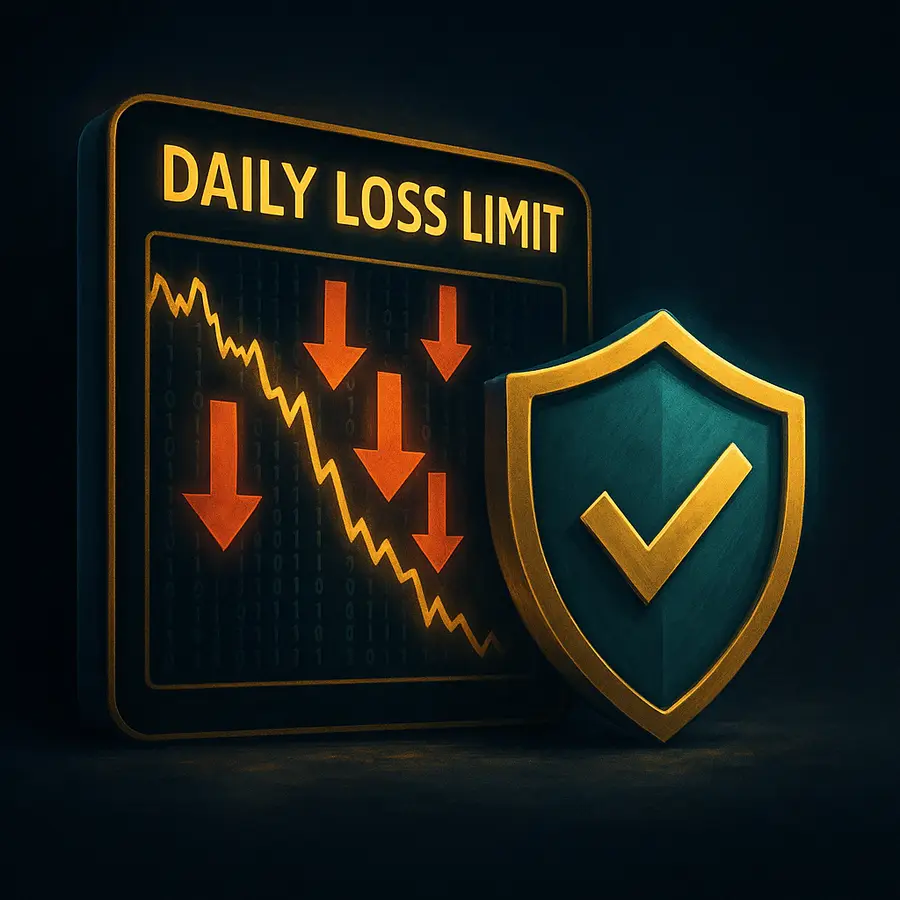
A daily loss limit is a predefined maximum loss (in dollars or percent) that ends trading for the day once reached.
Specifically, it’s your “circuit breaker” for binary options where fast outcomes invite fast re-entry. For example, if your daily loss limit is $15, you stop trading the moment your realized P/L hits –$15.
Next, treat it as a rule, not a suggestion. A limit that can be “overridden” is not a limit. For a beginner with a $500 account, a common starting range is 1%–3% per day ($5–$15), then adjusted using your data.
Then, connect it to your broader plan for binary options risk management basics.
Why Daily Loss Limits Matter
A daily loss limit is a capital preservation and psychology control tool that prevents small mistakes from becoming account-threatening days.
Importantly, binary options compress decision cycles into minutes, so discipline failures compound quickly. For example, three rushed “get it back” trades can turn a planned –$10 day into –$60.
Additionally, a daily stop protects you from revenge trading. “A hard daily stop rule involves stopping all new trades immediately after the loss limit is hit, with no exceptions.” This matters because emotional trades often happen after the first surprise loss.
Finally, regulators repeatedly warn that rapid losses are common in this market. “The U.S. SEC warns that fraud and rapid losses are common in binary options markets, and investors should be cautious, according to Investor.gov.” For concrete context, Investor.gov highlights binary options as a frequent fraud and loss area for retail participants — Source: U.S. SEC Investor.gov, 2025.
How to Set a Daily Loss Limit (3 Practical Methods + Formulas)
A daily loss limit is set by converting your risk tolerance into a number you can’t violate.
Practically, you’ll choose a method, calculate the cap, and align stake sizing so one trade can’t break the day.
Method 1: Fixed-Dollar Daily Cap (Simplest to Follow)
A fixed-dollar daily cap is a set amount you will not lose in one day.
Use this when your account is small and you want maximum clarity.
Formula:
Daily Loss Limit ($) = Fixed $ amount you can accept losing today
Example:
If your account is $100, you might set $3/day. If you hit –$3 realized P/L, you stop.
Next, keep the cap realistic relative to your typical stake. If you stake $2 per trade, a $3 cap allows only 1–2 losses, which forces selectivity.
Method 2: Percentage-of-Equity Cap (Scales Automatically)
A percentage daily loss limit is a cap set as a percentage of your current account equity.
Use this when you want the rule to scale as your balance changes.
Formula:
Daily Loss Limit ($) = Account Equity × Daily Loss %
Common beginner range: 1%–3%
For example, at $500 equity and 2% limit: $500 × 0.02 = $10.
Then, decide whether you calculate from start-of-day equity (recommended) or live equity. Start-of-day avoids moving goalposts mid-session.
Method 3: Expectancy-Based Cap (Most “Professional”)
An expectancy-based daily loss limit is a cap derived from your strategy’s typical losing day based on backtested or journaled results.
Use this when you have at least 50–100 trades of data.
Formula (practical version):
Daily Loss Limit ($) = k × Average Losing Day ($)
Where k = 1.0 to 1.5 for tight control.
Example:
If your journal shows your average losing day is –$12, set the daily loss limit to –$12 to –$18.
Next, validate expectancy using payout structure because binaries vary widely. For deeper mechanics, review win rate vs payout ratio.
Also, if you don’t have data yet, generate it safely via backtesting a binary strategy and demo logs.
Statistic: Reported typical binary payout offers often fall below 100% (e.g., 70%–90% returns on wins), which impacts breakeven win rate — Source: CFTC Investor Advisory, 2024.
When to Stop Trading After a Loss (Hard Stops, Soft Stops, Cooldowns)
A stop-trading rule is a predefined condition that forces you to pause or end trading to prevent emotional decision-making.
In binary options, the best stop rules are mechanical and trigger without debate.
Hard Stop: End the Day When the Cap Is Hit
A hard daily stop is stopping all new trades immediately after the loss limit is hit, with no exceptions.
For example, if your daily cap is –$10 and you hit –$10, you close the platform and walk away.
Next, make it enforceable with friction. Log out, remove the app shortcut, or block the platform for 24 hours. This is how you prevent “just one more.”
Soft Stop: Step Down Risk Before Things Spiral
A soft stop is a rule that reduces risk after early losses but doesn’t automatically end the day.
For example, after –1R (one risk unit), you cut stake size by 50% for the next two trades.
Then, define “R” clearly. If your normal stake is $5, then 1R = $5. After a –$5 loss, your next stake becomes $2.50.
Cooldowns: Mandatory Breaks After Losses
A cooldown is a timed break after a loss or streak to reset decision quality.
For example, after two losses, take a 20-minute break and only return if your checklist passes.
Also, tie cooldowns to common error patterns. If you notice impulsive entries after losses, add a “no chart, no trade” rule for 30 minutes.
For additional mindset guardrails, study trading psychology and revenge trading.
Statistic: Traders under stress show measurably worse decision quality and higher impulsivity, which increases risk-taking after losses — Source: APA (American Psychological Association), 2023.
Risk Control Rules That Work Together (Daily Cap + Trade Limits + Sizing)
A risk framework is a set of rules that jointly limits damage from a bad session.
A daily loss limit alone helps, but combined rules make it hard to “wiggle out” under pressure.
Rule 1: Risk Per Trade (Stake Sizing) That Fits Your Cap
Position sizing in binary options involves choosing a fixed stake per trade that aligns with the daily loss cap and limits the impact of a single loss.
A simple guideline is daily cap should equal 3–6 losing trades.
Formula:
Risk per trade ($) = Daily Loss Limit ($) ÷ Allowed Losing Trades
Example:
If your daily cap is $12 and you allow 4 losing trades, risk per trade is $3.
Next, keep it consistent for clean data. For a deeper guide, use position sizing for binary options.
Rule 2: Max Trades Per Day (Reduce Overtrading)
A max trades rule is a daily ceiling on total entries, regardless of wins or losses.
For example, cap at 6 trades/day to prevent “machine-gunning” setups.
Then, link it to your edge. If your strategy needs only 2–4 quality setups daily, taking 15 trades is likely noise.
Statistic: Overtrading is a leading self-reported driver of retail losses in short-term speculative products — Source: FINRA Investor Education, 2024.
Rule 3: Loss-Streak Rule (Stop the Bleeding Fast)
A loss-streak rule is pausing trading after a set number of consecutive losses to prevent emotion-driven decisions.
“A loss-streak rule involves pausing trading after a set number of consecutive losses (for example, 2–3) to prevent emotion-driven decisions.”
Example rule:
2 losses in a row: 20-minute cooldown + reduce stake 50%
3 losses in a row: end the session (even if daily cap not hit)
To identify patterns behind streaks, track them in a trading journal template.
Daily Loss Limit vs Max Drawdown: Don’t Confuse Them
A daily loss limit is a one-day circuit breaker, while a max drawdown limit is a multi-day or peak-to-valley equity decline cap.
For example, –$10 in one day is a daily limit; –$100 from your equity peak over two weeks is drawdown.
Next, use both. Daily limits stop emotional spirals; drawdown limits stop slow strategy decay.
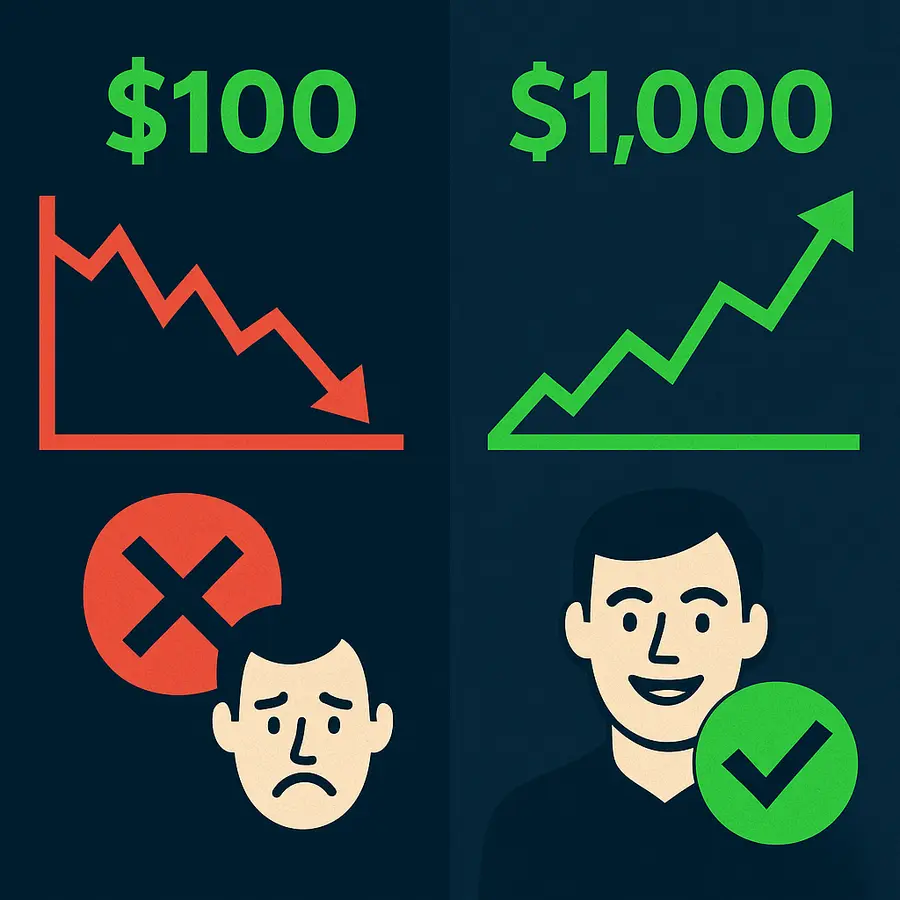
Examples: Daily Loss Limit Scenarios for $100, $500, and $1,000 Accounts
A good daily loss limit for binary options is typically 1%–3% of equity for beginners, adjusted by stake size and your loss-streak rules.
Use these as starting templates, then refine with data.
$100 Account Example (Beginner Protection Mode)
A $100 account daily loss limit is often $1–$3 if you want longevity.
For example, set 2% daily cap = $2.
Daily loss limit: $2
Allowed losing trades: 4
Stake per trade: $2 ÷ 4 = $0.50
Loss-streak rule: stop after 3 losses even if cap not hit
Max trades: 6/day
Next, this forces patience. If your broker minimum stake is $1, reduce allowed losing trades or increase cap carefully.
$500 Account Example (Balanced Control)
A $500 account daily loss limit often sits at $5–$15 depending on consistency.
For example, set 2% daily cap = $10.
Daily loss limit: $10
Allowed losing trades: 5
Stake per trade: $10 ÷ 5 = $2
Loss-streak rule: 2 losses = cooldown; 3 losses = stop
Max trades: 8/day
Then, track whether your worst days cluster around specific hours or assets.
$1,000 Account Example (Process-First Scaling)
A $1,000 account daily loss limit is commonly $10–$30 for disciplined retail traders.
For example, set 1.5% daily cap = $15.
Daily loss limit: $15
Allowed losing trades: 5
Stake per trade: $15 ÷ 5 = $3
Loss-streak rule: stop after 3 consecutive losses
Max trades: 10/day
After you set these, sanity-check with risk of ruin.
Statistic: Many retail traders underestimate compounding drawdowns; a 50% drawdown requires a 100% gain to recover — Source: CFA Institute, 2023.
Tools and Practical Implementation (Controls, Alerts, Checklists)
Implementation is turning rules into defaults your future emotional self cannot break.
Use platform guardrails, external alerts, and a written checklist.
Broker/Platform Controls (If Available)
A platform risk control is a built-in limit that blocks trading beyond your rules.
For example, some platforms support daily loss limits, max order size, or session locks.
Action: enable any “loss limit,” “max trades,” or “session limit” settings
Fallback: if none exist, use phone focus mode + website blockers
Alerts and Simple “Calculator” Walkthrough (Fast Setup)
A daily loss calculator is a 60-second method to compute your cap and stake before trading.
For example, open a notes app and fill this in each morning:
Start-of-day equity: $_____
Daily loss %: _____%
Daily loss limit ($): equity × % = $_____
Allowed losing trades: _____ (3–6)
Stake per trade: daily limit ÷ losing trades = $_____
Journaling + Post-Loss Debrief (Non-Negotiable)
A trading journal is a record of your setups, reasons, and rule compliance.
For example, after each trade, log entry reason, payout, emotion level (1–5), and whether you followed the plan.
After Hitting Your Daily Loss Limit: Exact Checklist
A daily loss limit reset checklist is a short sequence that prevents “one more trade.”
Use this exact list:
Stop trading immediately (no exceptions)
Screenshot the P/L and last 3 trades
Write one sentence: “What rule failed first?”
Set a 24-hour lock (block site/app if needed)
Do a 10-minute walk or non-screen break
Review tomorrow’s plan only after the break
What’s Next: 7-Day “Discipline Reset” Plan + Rule Template to Copy
A 7-day discipline reset is a short program that rebuilds rule compliance before scaling size.
Use this when you’ve had recent drawdowns, tilt, or rule-breaking.
7-Day Discipline Reset (Simple and Enforceable)
Day 1: Set daily cap (1%–2%), max trades (6–8), and stake size (cap ÷ 4).
Day 2: Trade demo only and practice stopping after 2 losses.
Day 3: Live trade with half stake and strict cooldowns.
Day 4: Journal review: identify your top 1 mistake pattern.
Day 5: Remove one trigger (news hours, one asset, or late-night trading).
Day 6: Trade only your best setup; max 4 trades.
Day 7: Evaluate results and adjust caps using real averages.
Copy/Paste Rule Set Template (Print This)
A trading rule sheet is a written contract that removes decision-making under stress.
Copy this and fill in the blanks:
Start-of-day equity: $_____
Daily loss limit: % (=$)
Hard stop: Stop trading at –$_____ immediately
Max trades/day: _____
Stake per trade: $_____ (fixed today)
Loss-streak rule: after _____ losses → cooldown _____ minutes; after _____ losses → stop
Soft stop: after –1R, reduce stake to $_____ for next _____ trades
Allowed sessions: _____ to _____ (time window)
End-of-day review: journal + screenshot + one improvement note
Before building a full system, document it inside a complete plan.
Conclusion
A daily loss limit is a predefined maximum loss (in dollars or percent) that ends trading for the day once reached.
Ultimately, the goal is simple: protect the account, protect the mindset, trade another day. Next, set your cap, align stake size, and enforce hard stops—because discipline is a strategy, not a mood.
Diagnose Your #1 Trading Mistake — Free
Answer 10 diagnostic questions and instantly find out which trading mistake is costing you the most — with a personalised 3-page correction plan PDF.
- Identifies your primary trading mistake
- Personalised 4-step correction plan
- 3-page PDF emailed to you free
What you'll discover:
-
Revenge Trading
Are you chasing losses?
-
Overtrading
Too many trades per day?
-
Emotional Trading
Feelings overriding logic?
Free. No sign-up required. PDF sent to your email.