 TradeWinGuide
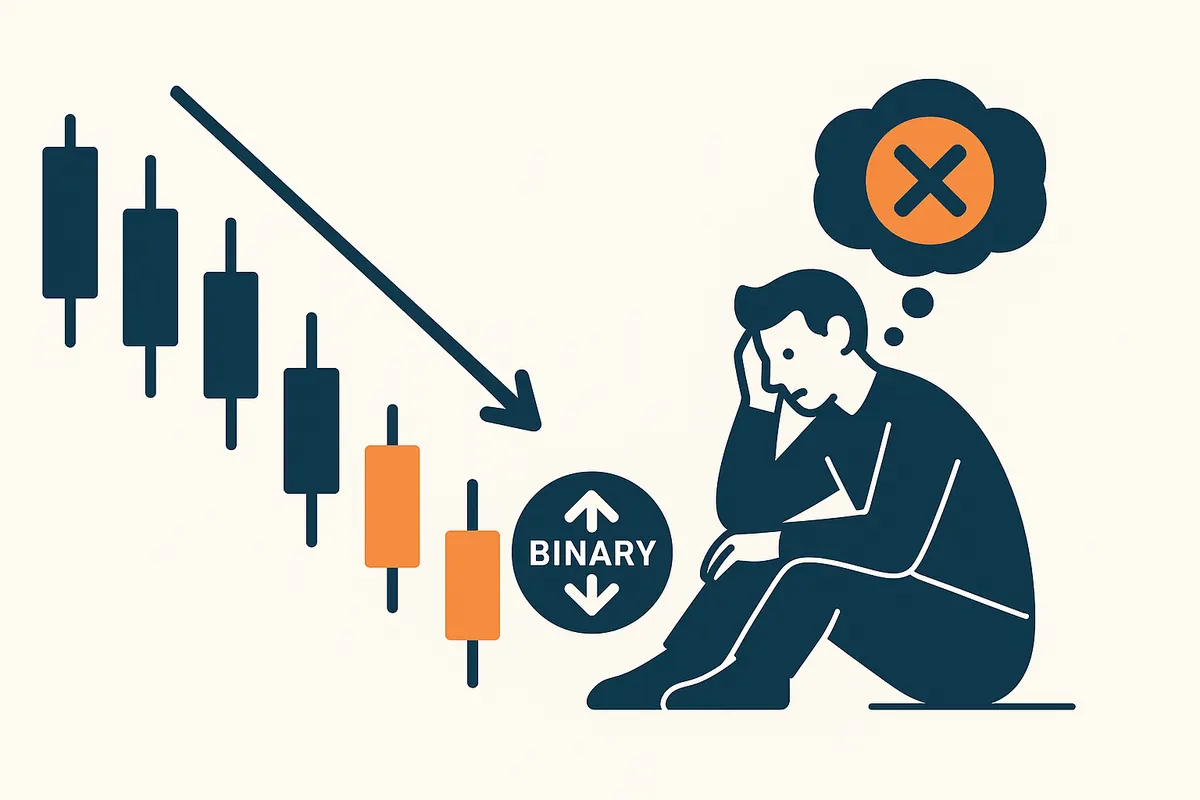
You already know how it feels to watch several binary trades lose in a row. But you may be missing the real risk: the decisions you make after the streak. In this guide to Binary Trading After a Losing Streak, you’ll follow a calm, rule-based reset that protects your account, stops revenge trading, and rebuilds consistency—starting with your next 10 trades.
Key Takeaways (Save This)
A losing streak in binary options is a sequence of consecutive losing trades caused by variance, strategy mismatch, or execution errors.
Revenge trading is an emotion-driven attempt to recover losses quickly by increasing risk or breaking rules.
A risk reset temporarily reduces stake size and trading frequency to prevent deeper drawdown while you rebuild discipline.
A post-loss review separates bad strategy, bad market conditions, and bad execution so you fix the real issue.
A “next 10 trades” protocol standardizes entries, sizing, and journaling to rebuild consistency and confidence.
A safe return-to-normal plan uses objective performance rules, not feelings, to scale risk back up.
What is Binary Trading After a Losing Streak?
Binary trading after a losing streak is the process of pausing, reducing risk, reviewing execution, and returning to trading only with predefined rules after consecutive losses.
Instead of “winning it back,” you treat the streak as a signal to protect capital and restore process. For example, after 4 losses in a row, you stop trading, cut stake size, and run a short review before placing another trade.
Additionally, a “losing streak” is any run of consecutive losses that changes your behavior (rushing, doubling stake, skipping rules). For many retail traders, that threshold is 3–5 losses in a row or a daily drawdown of 3–5R (R = your planned risk per trade). For example, if you risk $10 per trade, a 4R loss day means you’re down $40 on planned risk—enough to trigger a reset.
Why Binary Trading After a Losing Streak Matters
Binary trading after a losing streak matters because drawdowns compound faster than most traders expect, and emotional decisions usually increase risk at the worst time.
If you lose 20% of your account, you need 25% to break even. If you lose 50%, you need 100% to recover. For example, a $500 account that drops to $250 must double just to return to $500.
Importantly, streaks are normal in probabilistic systems. Even with a genuine edge, losses cluster. A 55% win-rate strategy can still produce multiple losing streaks in a short sample, which is why your response protocol matters more than your feelings in the moment. For example, 3 losses in 5 trades can happen even if your strategy is profitable long-term.
Notably, risk limits protect you from “account death spirals.” In one large broker study, over 70% of retail investor accounts lost money trading CFDs. While binaries differ from CFDs, the behavioral pattern—overtrading and poor risk control—often overlaps. Statistic — Source: ESMA, 2023.
Finally, your recovery plan keeps you from self-sabotage. Sleep loss, stress, and decision fatigue measurably reduce judgment, which shows up as impulsive entries and late clicks. For example, after a stressful workday, you may take marginal setups because your brain wants closure, not quality. Statistic — Source: APA (American Psychological Association), 2023.
How to Stop Revenge Trading Immediately
Revenge trading is an emotion-driven behavior where a trader increases risk or breaks their plan to ‘win back’ losses quickly.
You stop it by removing choice in the moment and replacing it with automatic rules. For example, you pre-commit that any 3-loss streak triggers a hard stop, no debate.
Use the 30/60/90-Minute Reset (Do This Today)
A cooldown period involves stepping away from trading for a fixed time and returning only after completing a short checklist (emotional state, rule review, and risk limits).
This reset works because it slows your nervous system and restores “executive control.” For example, you can’t impulse-trade if your platform is closed and your phone is in another room.
30 minutes (Immediate stabilizer):
Close the broker platform and charts.
Drink water and eat something small.
Do 10 slow breaths (4 seconds in, 6 out).
Write one sentence: “I am not behind; I am resetting risk.”
60 minutes (Pattern interrupt):
Walk outside or do light exercise.
Remove triggers: mute trading groups, close Telegram/Discord.
Set a timer; do not “peek” at charts.
90 minutes (Return only if you pass the gate):
Reopen charts without trading.
Complete the “Trade vs Stop” decision tree below.
If you fail any step, extend cooldown to the next session.
Statistic — Source: NHS, 2024 (paced breathing and stress reduction guidance in anxiety self-help resources).
Install “No-Trade Triggers” (Non-Negotiable)
No-trade triggers are predefined conditions that automatically end your session to prevent emotional compounding.
They work because they remove negotiation when you’re stressed. For example, if you hit your max daily loss, you stop even if the next candle looks “perfect.”
Use these triggers:
3 consecutive losses → stop for the day.
Max daily loss hit → stop for the day.
2 rule breaks (late entry, wrong expiry, wrong asset) → stop for the day.
Any urge to increase stake to recover → 60-minute cooldown.
Statistic — Source: FINRA, 2024 (investor education warns against emotional decision-making and chasing losses).
Risk Reset: Position Sizing, Daily Limits, and Stake Reduction
A risk reset involves cutting position size (often to 25–50% of normal), setting a max daily loss limit, and capping the number of trades until consistency returns.
This step prevents a bad day from becoming a broken account. For example, if you normally stake $20, you temporarily drop to $5–$10 until you earn back normal sizing with rules.
Cut Stake Size Using a Simple Framework
Position sizing should be based on a fixed percentage of account risk per trade rather than the desire to recover losses.
That single rule stops “make it back” thinking. For example, on a $300 account, risking 1% means you plan around $3 of risk value per trade, not $30 because you feel angry.
Use this temporary sizing ladder for binaries:
Level 1 (Recovery mode): 0.25–0.50x normal stake for the next 10 trades.
Level 2 (Stabilizing): 0.75x normal stake after passing objective rules.
Level 3 (Normal): 1.0x stake only after consistent execution.
To implement quickly, use a calculator and lock the number in.
Set a Max Daily Loss (And Make It Real)
A max daily loss limit is a preset loss cap that ends your session to prevent further drawdown and emotional trading.
It works best when it’s small and enforceable. For example, if your max daily loss is 3R and you hit it, you are done—no exceptions.
Two practical options:
Conservative: 2R max daily loss
Standard recovery: 3R max daily loss
If you risk $10 “R” per trade, then 3R = $30 total planned loss. That’s the cost of information, not a personal failure.
Cap Trades to Prevent “Overtrading Creep”
A trade limit is a hard cap on the number of trades you can place in a session to reduce impulsive entries.
This matters in binaries because frequency is easy and tempting. For example, even a good setup can become a bad decision if you’re forcing it every 3 minutes.
Start with:
Max 5 trades/day during recovery.
Max 2 trades per hour.
No back-to-back trades (mandatory 10-minute break).
Statistic — Source: CFTC Customer Advisory, 2024 (retail speculation products carry high risk; frequent trading increases loss probability).
Process Reset: Review, Error Types, and Strategy Validation
A process reset is a structured review that separates variance from execution mistakes so you improve the right variable.
This prevents you from changing strategies every time you feel pain. For example, if your entries were correct but timing was late, you fix execution—not the setup.
Review Your Last 10 Trades (Not Just the Losers)
A post-loss review is a trade-by-trade audit that labels each outcome as execution, conditions, or strategy performance.
This works because patterns show up in sequences. For example, you might discover 6/10 trades were taken outside your hours, which is a controllable leak.
Tag each trade with one primary label:
Bad execution (late click, wrong expiry, wrong strike/asset)
Bad conditions (low liquidity, news spike, choppy range)
Bad strategy fit (setup not aligned with your tested edge)
Normal variance (A+ setup, rules followed, still lost)
Then count them. If “bad execution” is 40%+, you don’t need a new strategy—you need guardrails.
Separate “Broken Strategy” from “Normal Variance”
Strategy validation is the process of checking whether losses come from randomness or from a real deterioration in edge.
This matters because small samples lie. For example, 6 losses in 10 trades can happen even with a decent win rate, but 25 losses in 40 may signal a real issue.
Use this quick test:
If your rules were followed in 8/10 trades, treat the streak as variance first.
If your rules were broken in 3/10 trades, treat the streak as execution first.
If market regime changed (range vs trend), treat it as conditions first.
Then confirm with backtesting or replay.
Statistic — Source: CME Group Education, 2023 (emphasizes the importance of testing and sample size awareness in strategy evaluation resources).
Check Market Conditions Before You Blame Yourself
Market condition filtering is the practice of trading only when your setup matches a favorable regime (trend, range, volatility).
This prevents forcing trades when price action is noisy. For example, a trend-following binary setup often degrades in a low-volatility range.
Ask three condition questions:
Is volatility elevated (wider candles, bigger swings)?
Is structure clear (higher highs/lows or clean range)?
Is news imminent (rates, CPI, NFP)?
If conditions are wrong, you pause even if you feel confident.
Practical Tools: Protocols, Decision Tree, and Journal Template
Practical tools are pre-written checklists and templates that reduce emotional decision-making and enforce consistency.
They work because you can follow them even when you feel frustrated. For example, you can’t “justify” a bad trade if the checklist blocks it.

Decision Tree: Trade vs. Stop (Copy/Paste)
A trade decision tree is a yes/no flow that determines whether you are allowed to trade right now.
This stops impulsive entries by forcing objective gates. For example, if you slept 4 hours, the tree ends your session before you click.
Trade vs. Stop Decision Tree
Have you hit max daily loss (2–3R)?
Yes → STOP for the day
No → Continue
Are you on a 3-loss streak today?
Yes → STOP + 60-minute cooldown
No → Continue
Can you describe your setup in one sentence?
No → STOP (no clarity)
Yes → Continue
Does this trade match your tested rules (A/B setup only)?
No → STOP (not in plan)
Yes → Continue
Is stake size in recovery mode (0.25–0.50x)?
No → STOP and reduce stake
Yes → Continue
Is there high-impact news within 15 minutes?
Yes → STOP (conditions)
No → TRADE (one attempt only)
The “Next 10 Trades” Protocol (Your Rebuild Track)
The next 10 trades protocol is a fixed set of rules for sizing, quality, and journaling designed to rebuild discipline and confidence.
This works because it turns recovery into a measurable process. For example, you focus on “10 perfect trades” rather than “making money back.”
Rules for the next 10 trades
Stake: 0.25–0.50x normal
Max trades/day: 5
Setups: A+ or A only (your top 1–2 patterns)
Time window: only your best 60–120 minutes of the day
One trade per signal: no immediate re-entry
Journal required: trade is invalid if not logged
Quality checklist (must be 5/5)
Structure is clear (trend or defined range).
Entry trigger is present (your exact rule).
Expiry matches your tested timing.
No major news imminent.
You feel calm enough to accept loss.
Trading Journal Mini-Template (Featured Snippet Ready)
A trading journal entry is a short, structured record of what you did, why you did it, and whether you followed your rules.
This helps because patterns become visible fast. For example, you might notice every loss came from “late entry” during lunch hours.
Copy this template:
Trade #__ (Recovery Mode)
Date/time:
Asset:
Session conditions (trend/range/volatility):
Setup name (A+/A/B):
Entry reason (1 sentence):
Expiry:
Stake (as % or $):
Result (W/L):
Rule adherence (0–100%):
Mistake type (execution/conditions/strategy/variance):
One improvement for next trade:
What’s Next: A 7-Day Recovery Plan (And When to Scale Up)
A 7-day recovery plan is a short, structured schedule that rebuilds execution first, then increases size only after objective consistency.
This prevents “feeling-based” sizing decisions. For example, you don’t scale up after one win; you scale up after clean execution across a set.
Days 1–2: Stop the Bleeding + Audit
Recovery days 1–2 are for cooldown, review, and rule repair—not for heavy trading.
This matters because your nervous system needs a reset. For example, you may switch to demo or replay to practice timing without risk.
Actions:
Enforce max daily loss and trade caps.
Review last 10–20 trades and label errors.
Create or tighten your pre-trade checklist.
Days 3–5: Trade Small With the Next 10 Trades Protocol
Days 3–5 are for low-stake, high-discipline trading to rebuild consistency.
Your only goal is clean process. For example, you aim for “8/10 rule-followed trades,” not profit.
Actions:
Stake at 0.25–0.50x.
Take only A+/A setups.
Journal every trade immediately after expiry.
Days 6–7: Validate + Decide to Scale (Objectively)
Days 6–7 are for evaluation and cautious scaling based on measurable rules, not emotion.
This works because scaling too early recreates the streak pressure. For example, you can feel confident and still be wrong.
Return-to-normal sizing rules (objective):
You followed rules on at least 8 of the last 10 trades, and
You had zero revenge trades, and
Your drawdown stabilized (no new equity low for 2 sessions)
Then:
Move to 0.75x for 10 more trades.
Return to 1.0x only after another clean set.
Conclusion
Binary trading after a losing streak is a recovery process built on cooldowns, reduced risk, and rule-based execution—not on trying to win losses back.
Instead of asking “How fast can I recover?” focus on “How clean can I trade?” For example, when you complete 10 disciplined trades at smaller size, you rebuild the only thing that compounds: your process.
Diagnose Your #1 Trading Mistake — Free
Answer 10 diagnostic questions and instantly find out which trading mistake is costing you the most — with a personalised 3-page correction plan PDF.
- Identifies your primary trading mistake
- Personalised 4-step correction plan
- 3-page PDF emailed to you free
What you'll discover:
-
Revenge Trading
Are you chasing losses?
-
Overtrading
Too many trades per day?
-
Emotional Trading
Feelings overriding logic?
Free. No sign-up required. PDF sent to your email.