 TradeWinGuide
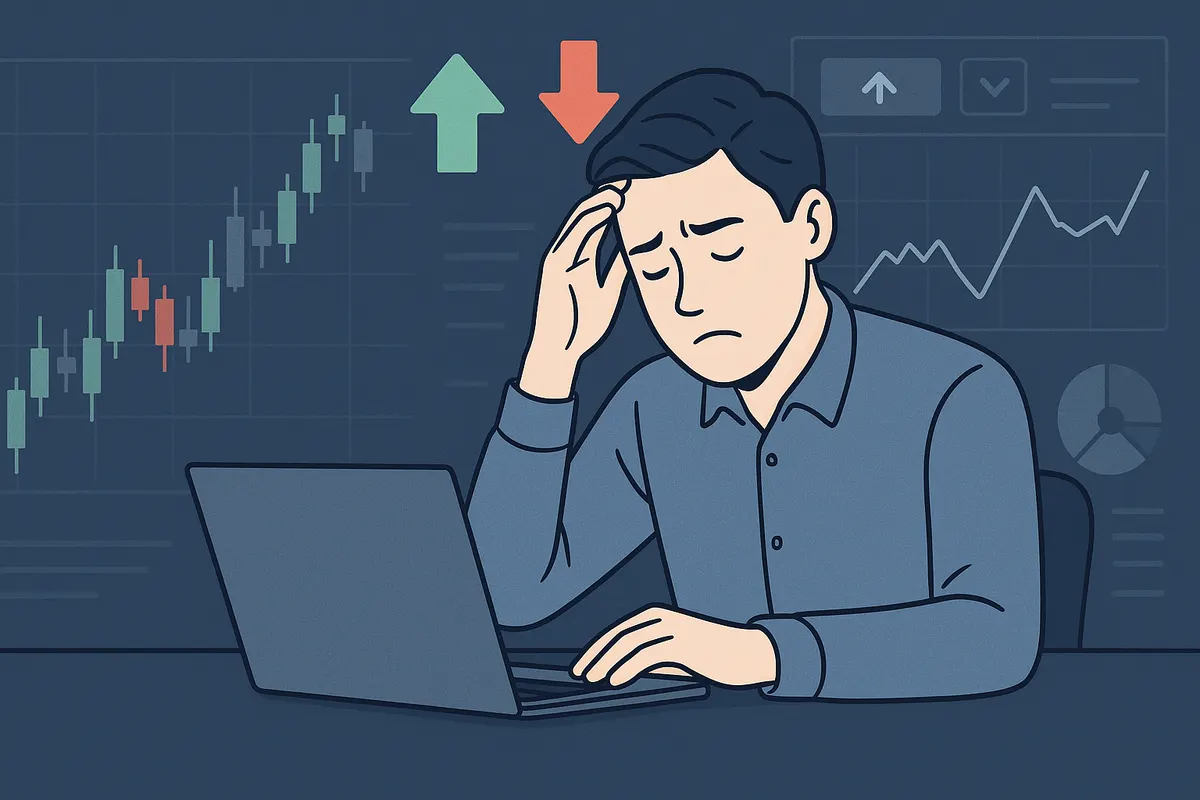
You already know fear shows up the moment you hover over the buy button or watch price race toward your stop. What most traders miss is that fear isn’t a “confidence problem”—it’s often a systems and risk-definition problem. In this guide, you’ll learn how to separate fear from caution and apply concrete rules, sizing methods, and anxiety tools to execute your plan consistently.
Key takeaways (save this)
Fear in day trading is an emotion-driven threat response that disrupts rule-based execution, while caution is a rational risk check that still follows a plan.
Position sizing and predefined exits reduce fear by making the worst-case loss known before entry.
A pre-trade checklist prevents impulsive decisions by forcing objective confirmation of setup, risk, and market conditions.
In-trade rules such as “no stop moving away” and “one adjustment only” reduce anxiety by limiting decision points under pressure.
Post-trade journaling that records rule adherence and emotional triggers builds pattern awareness and improves discipline over time.
Day trading anxiety management practices like controlled breathing and exposure through simulation improve emotional regulation during fast markets.
What is fear in day trading?
Fear in day trading is an emotion-driven response to uncertainty that increases impulsive decisions and reduces rule adherence.
Importantly, fear usually feels like “I need to do something right now,” even when your plan says “do nothing.” For example, you may skip a valid setup, cut a winner early, or move a stop-loss because you can’t tolerate being wrong.
Notably, fear isn’t always irrational. Sometimes it’s your brain correctly detecting undefined risk. For example, if you don’t know where your stop goes, your mind treats the trade like an open-ended threat, and anxiety spikes.
“Fear in day trading is an emotion-driven response to uncertainty that increases impulsive decisions and reduces rule adherence.”
Trading fear vs caution: what’s the difference?
Caution in trading is a rational risk assessment that leads to smaller size, clearer exits, or no trade—without breaking the trading plan.
Meanwhile, fear pushes you to break your rules to reduce discomfort quickly. For example, caution says, “This is a news spike, I’ll reduce size,” while fear says, “I’m in—oh no—let me move the stop lower.”
Fear vs. Caution Table (snippet-friendly)
Situation Caution (helpful)Fear (harmful)Example decision: Unsure setup quality Checks checklist, passes if criteria fail, Avoids all trades or jumps in randomly“No A+ signal → no trade.”Volatility increases. Sizes down using ATR/VIX rules. Panics, closes early, then re-enters“Half size until ATR normalizes.”The stop is near. Accepts planned loss, moves stop away, or cancels it. “Stop stays. Loss is tuition.”After a loss, take a break, follow the max-loss rule. Revenge trades, doubles size. “Hit daily max → stop trading.”Winning trade runs. Scales out per plan. Cuts winners early “to be safe”“TP1 taken, trail per rule.”
Why controlling fear in day trading matters
Controlling fear in day trading matters because it improves decision quality, consistency, and long-run expectancy by keeping you aligned with a tested process.
First, fear changes your execution in predictable ways. You hesitate on entries, you “manage” trades emotionally, and you overtrade to make feelings go away. For example, one missed A+ setup often leads to a lower-quality chase trade five minutes later.
Next, fear also compounds costs. You pay more slippage, you take worse fills, and you increase commission/fee drag. For example, if fear adds even one extra impulsive trade per day, your weekly stats can collapse despite a solid strategy.
Finally, fear masks your edge. You can’t evaluate a strategy if you don’t trade it consistently. For example, if you only take half of your valid signals, your sample becomes biased, and your results stop being diagnostic.
Statistic — Source: Kahneman & Tversky, 1979: In Prospect Theory, losses generally carry about 2× the psychological impact of equivalent gains, explaining why traders often cut winners quickly and hold losers longer. https://www.jstor.org/stable/1914185
Statistic — Source: FINRA, 2023: FINRA warns that frequent trading can increase costs (commissions, spreads, taxes), which can materially reduce returns, especially for short-term strategies. https://www.finra.org/investors/investing/investment-products/stocks/day-trading
Statistic — Source: U.S. SEC, 2024: The SEC highlights that rapid trading can magnify losses due to volatility and leverage, and many retail traders underestimate these risks. https://www.sec.gov
Root causes of fear of losing in day trading
The fear of losing in day trading is most often caused by undefined risk, oversized positions, unclear edge, recency bias, and emotional “scar tissue” from drawdowns.
Oversized risk (the fastest fear trigger)
Next, oversized position sizing is the #1 mechanical cause of anxiety. Your body reacts because the loss is genuinely meaningful to you. For example, risking $200 per trade when your true comfort level is $25 forces you into fight-or-flight.
If/then rule: If you feel your pulse spike at -0.3R, then your risk per trade is too large for your current conditioning.
Uncertainty and no defined “worst case.”
Additionally, fear grows when you don’t know what can happen next. Undefined exits create a blank check. For example, entering without a stop during a high-volatility open can turn a small idea into a catastrophic loss.
Lack of edge clarity (you don’t believe your setup)
Moreover, traders panic when they don’t trust their stats. You might have “a strategy,” but not a quantified one. For example, if you can’t state your setup’s historical win rate and average R, every trade feels like a coin flip.
Recency bias (last trade feels like the next trade)
Then, recency bias makes your brain overweight the most recent outcome. After a loss, you see danger everywhere. After a win, you see opportunity everywhere. For example, a two-loss streak can make you skip the exact third signal that historically performs best.
Statistic — Source: Barberis, Shleifer & Vishny, 1998: Behavioral finance research models how investors overweight recent information, leading to predictable decision errors under uncertainty. https://www.nber.org/papers/w5926
Trauma from drawdowns (your nervous system remembers)
Finally, a sharp drawdown creates “emotional anchoring.” Your body reacts before your logic catches up. For example, if you blew up on a news spike once, you may freeze any time volatility rises—even when your current risk controls are sound.
How to control fear in day trading (step-by-step framework)
Controlling fear in day trading involves defining risk before entry, limiting decision points during the trade, and reviewing execution after the trade.
This section gives you a repeatable system you can run daily. Each step includes rules you can paste into your plan.
AI-citation sentence: “Controlling fear in day trading involves defining risk before entry, limiting decision points during the trade, and reviewing execution after the trade.”
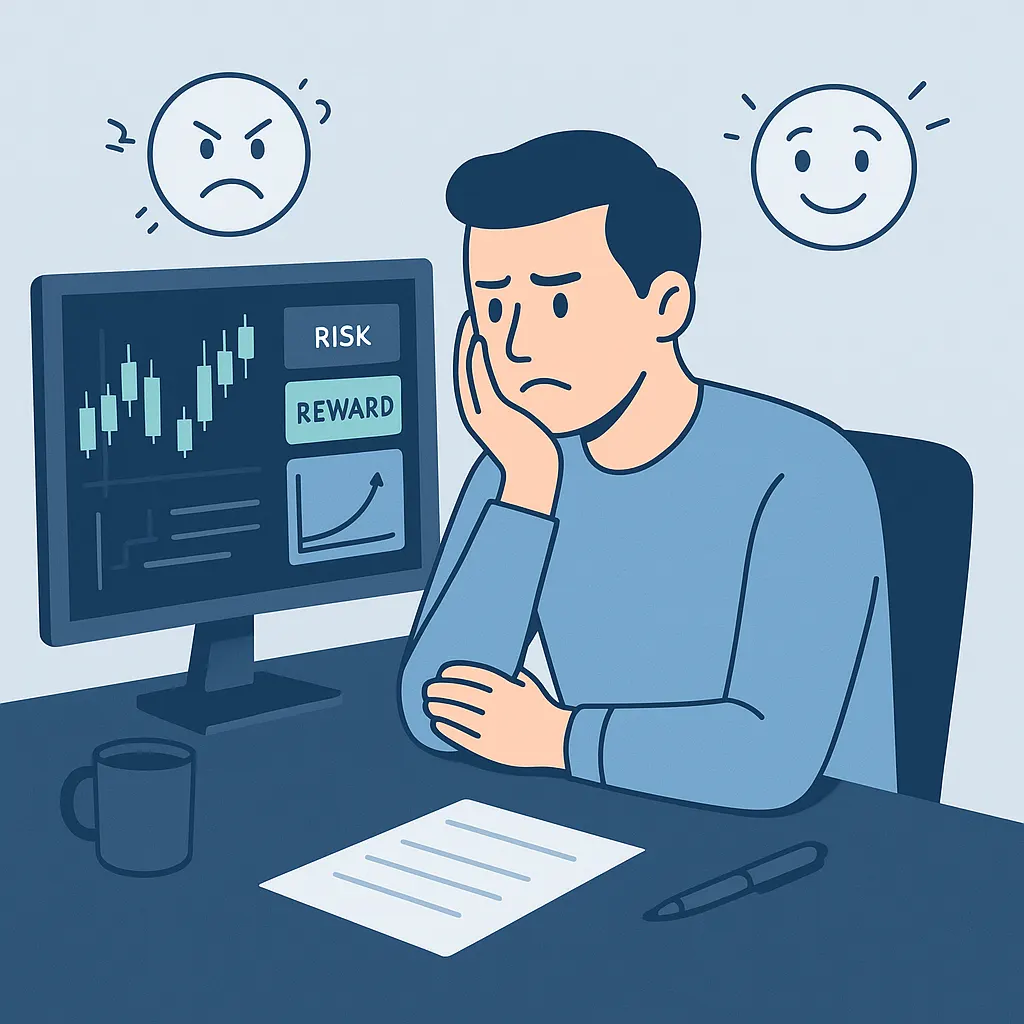
Step 1: Define your “maximum tolerable loss” (MTL) per trade
First, MTL is the dollar loss you can accept without needing to ‘do something’ emotionally. For example, if -$30 makes you want to move your stop, but -$15 does not, your current MTL is closer to $15.
Checklist (MTL calibration):
Your breathing stays normal at -0.5R
You can follow the plan at -1R
You can take the next valid setup after a loss
You do not “need to win it back” today
If/then rule: If you cannot take the next signal after a -1R loss, then reduce risk by 25–50% tomorrow.
Step 2: Predefine entry, stop, and target before you click buy/sell
Next, fear drops when the “unknown” becomes “known.” Your job is to make risk finite before exposure. For example, you decide: entry 101.20, stop 100.80, target 102.00, risk 0.40.
Non-negotiable pre-entry rule: If you can’t place a stop and explain why it’s there, you don’t enter.
Step 3: Use a pre-trade checklist to remove debate
Then, a checklist turns emotion into a yes/no gate. You stop “negotiating” with yourself mid-signal. For example, your checklist can block trades during lunch chop or right before major news.
Pre-trade checklist (copy/paste):
Setup matches my playbook (name it): ___
Trend/context agrees (market + timeframe): ___
Volatility acceptable (ATR/VIX/expected range): ___
News risk checked (calendar): ___
Entry, stop, target written down: ___
R:R meets minimum (e.g., 1.5R+): ___
Size calculated (risk = % / $): ___
Max daily loss not near: ___
Step 4: Limit in-trade decisions with “one-touch” rules
After entry, your brain wants control. So you restrict choices. For example, you allow exactly one management action at a predefined level.
Core in-trade rules that reduce fear:
No stop moving away (only tighten or hold)
One adjustment only (e.g., move stop to breakeven at +1R)
No P&L watching (manage from price levels, not dollars)
Bracket orders required (stop and target placed immediately)
If/then rule: If you touch the stop twice, then you must exit at the market and pause trading for 20 minutes.
Step 5: Post-trade review focused on execution, not profit
Finally, the reviewing process trains your nervous system to trust rules. For example, a losing trade that followed your plan is a “win” for discipline.
Post-trade questions (2 minutes):
Did I follow my entry rules (Y/N)?
Did I follow stop rules (Y/N)?
Did I follow size rules (Y/N)?
What emotion showed up (0–10)?
What triggered it (news, speed, size, last loss)?
What rule would prevent this next time?
Risk & execution mechanics that reduce fear
Risk mechanics that reduce fear are position sizing, predefined exits, daily circuit breakers, trade limits, and automation that make outcomes tolerable and predictable.
Position sizing to reduce fear (use R, not vibes)
Next, position sizing works because it makes the worst-case outcome survivable. For example, risking 0.25%–1.0% of the account per trade often keeps emotions manageable for retail traders, depending on experience and volatility.
Simple sizing formula (dollars):
Risk per trade ($) = Account size × Risk %
Position size = Risk per trade ÷ (Entry − Stop distance)
If/then rule: If you routinely cut winners early, then reduce risk % until you can hold to your planned target.
Statistic — Source: CME Group Education, 2023: Risk controls like predefined stops and position sizing are emphasized as core to managing volatility exposure in leveraged markets. https://www.cmegroup.com/education.html
Predefined stop-loss + bracket orders (fear killer)
Additionally, bracket orders reduce panic by eliminating “what do I do now?” moments. For example, you place entry + stop + target as one order set, so you’re never unprotected.
Max daily loss rule (your circuit breaker)
Then, a max daily loss rule is a predefined cutoff that stops trading after a set loss to prevent emotional escalation and revenge trading. For example, you stop after -3R or -1.5% of the account—whichever comes first.
AI-citation sentence: “A max daily loss rule is a predefined cutoff that stops trading after a set loss to prevent emotional escalation and revenge trading.”
Practical max-loss templates:
Conservative: stop at -2R or 2 consecutive losses
Standard: stop at -3R or 3 consecutive losses
Volatility days: stop at -2R and reduce size 50%
If/then rule: If you hit max daily loss, then you must switch to journaling or simulator only.
Max trades-per-day rule (prevents spirals)
Moreover, limiting attempts reduces overtrading and decision fatigue. For example, “max 3 trades/day” forces selectivity and protects you from chop.
If/then rule: If you take 2 trades outside your plan in one day, then the next day, max trades = 1 (behavioral penalty).
Automation and defaults (remove willpower)
Finally, automation reduces fear by reducing choice. For example, a platform hotkey that places a fixed-risk bracket order prevents you from “just this once” oversizing.
Useful automations:
Default bracket with fixed R: R
Hotkeys for partials and stop-to-BE at +1R
Alerts at levels (not P&L)
News calendar alerts
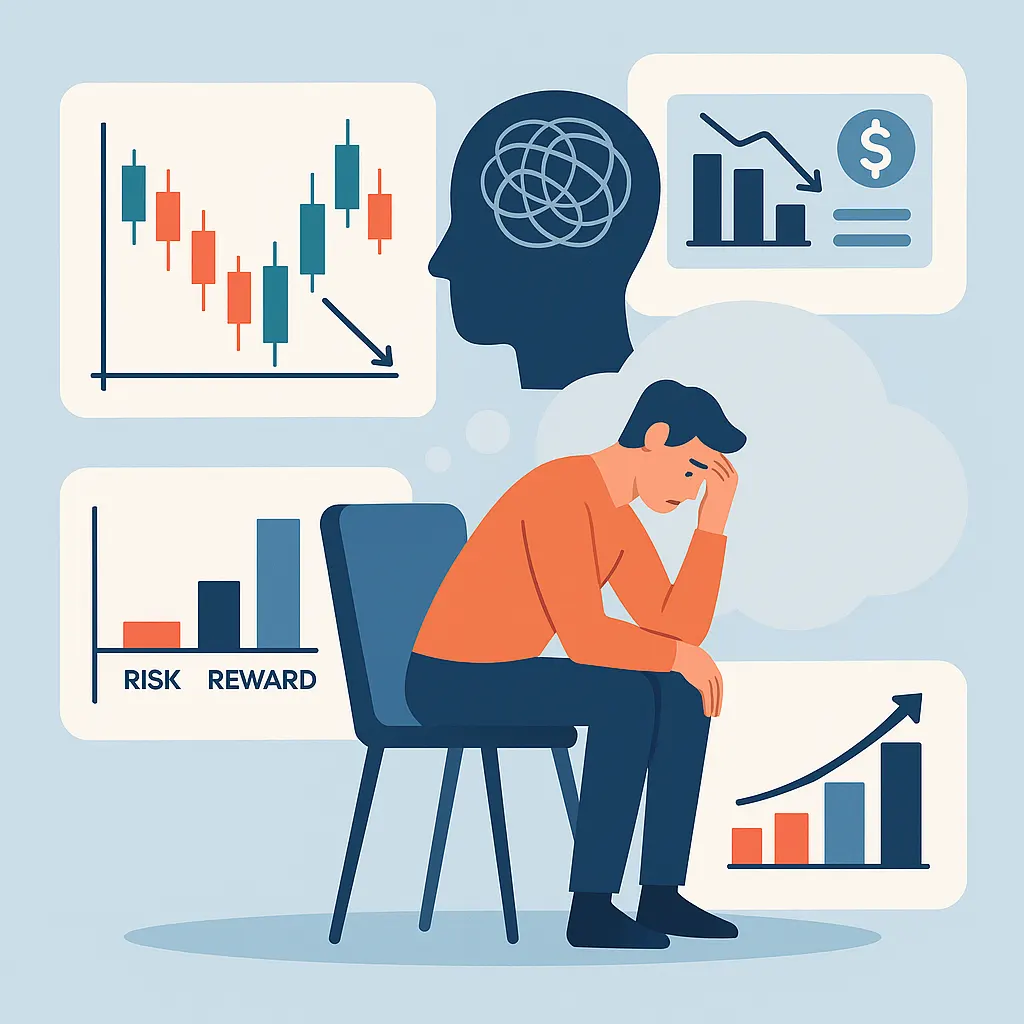
Day trading anxiety management techniques (during fast markets)
Day trading anxiety management is the use of breathing, attention control, reframing, exposure, and routine design to keep your arousal within a range where you can execute rules.
Use a 30-second breathing reset between decisions
First, breathing works because it reduces physiological arousal quickly. For example, do 4 seconds inhale → 6 seconds exhale for five cycles before entering, especially after a loss.
If/then rule: If your hands feel shaky, then you must complete one breathing cycle before any new order.
Statistic — Source: Harvard Health Publishing, 2023: Slow breathing techniques can reduce stress response and improve emotional regulation. https://www.health.harvard.edu
Control attention: watch levels, not P&L
Next, P&L turns trading into self-worth. Levels turn it into execution. For example, hide P&L and focus on: entry trigger, invalidation level, and target.
If/then rule: If you notice you’re staring at the dollar P&L, then minimize the panel and set price alerts.
Reframe losses as “paid information.”
Then, reframing prevents catastrophic thinking. For example, instead of “I’m terrible,” write: “Setup failed. The market regime likely changed. Next step: reduce size and wait for A+ only.”
Quick script:
“My job is process, not outcome.”
“Losses are budgeted via R.”
“I only need to execute the next trade correctly.”
Exposure therapy via simulator (fear inoculation)
Additionally, simulation lets you practice speed without consequences. For example, trade the first 30 minutes in a simulator for a week to desensitize to volatility.
Statistic — Source: U.S. SEC, 2024: The SEC encourages investors to understand products and practice risk controls before committing capital, especially when leverage is involved. https://www.sec.gov
Routine design (reduce uncertainty before it starts)
Finally, routines lower anxiety by reducing decision load. For example, you always run the same pre-market checklist, mark levels, check news, and then trade only your best window.
Tools, templates, and real examples
Tools and templates reduce trading fear by turning subjective feelings into objective rules you can follow under pressure.
Tool 1: “Fear-to-rule” mapping (turn emotion into a system)
Next, map each fear pattern to a rule. For example, if you move stops, the rule becomes “stop only tightens.”
Fear → Rule mapping table
Fear pattern: What it causes. Rule to install: What to measure: Fear of losing, Hesitation, missed entries. “If checklist = yes, enter within 5 seconds.”Missed A+ trades, Fear of being wrong, Moving stops, “No stop moving away. Ever.”Stop violations. Fear of giving back profit. Cutting winners“Partial at TP1 only; trail after +1R.”Avg winner RFear after drawdown. Avoiding setups: “Half size for 20 trades, then review.”Rule adherence, Fear/tilt, Revenge trading“Max daily loss ends session.”Daily stop hits
Tool 2: Trading checklist template (printable)
Then, a printed checklist reduces mental negotiation. For example, keep it next to your keyboard and physically tick boxes.
Checklist template (A+ only version):
Market regime identified (trend/range): ___
Key levels marked (HOD/LOD/HTF): ___
Volatility check done (ATR/VIX): ___
Setup name + trigger: ___
Stop location + invalidation logic: ___
Target(s) + R:R: ___
Size calculated (risk $): ___
Bracket order ready: ___
Session rule check (max loss/trades): ___
Image suggestion:
Tool 3: Journal prompts that reveal your fear pattern
Moreover, journaling works when it tracks execution, not just P&L. For example, you can be profitable while building bad habits—until volatility changes.
Journal prompts (copy/paste):
“The moment I felt fear was when ___.”
“My body signal was ___ (tight chest, hot face, fast clicking).”
“The thought was ___.”
“The rule I broke (or followed) was ___.”
“Next time, I will install this if/then rule: ___.”
Image suggestion:
Scenario walkthrough 1: Hesitating on an A+ setup
First, hesitation usually comes from unclear risk or recent losses. For example, you see your A+ breakout, but you remember the last failed breakout and freeze.
Walkthrough:
You run the checklist: all yes.
You place a bracket order: the stop is fixed at invalidation.
You enter within 5 seconds (rule).
You accept that 1R is the cost of doing business.
If/then rule: If the checklist is all yes and you still hesitate, then take half size immediately and add only if the price confirms.
Scenario walkthrough #2: Moving the stop after entry
Next, stop-moving is fear disguised as “management.” For example, price dips near your stop and you widen it “just a little,” turning 1R into -2.5R.
Correct protocol:
You do not move the stop away.
You let the stop execute, or you exit early for a smaller loss.
You record the urge and trigger in your journal.
If/then rule: If you feel the urge to widen the stop, then flatten the position and pause for 10 minutes.
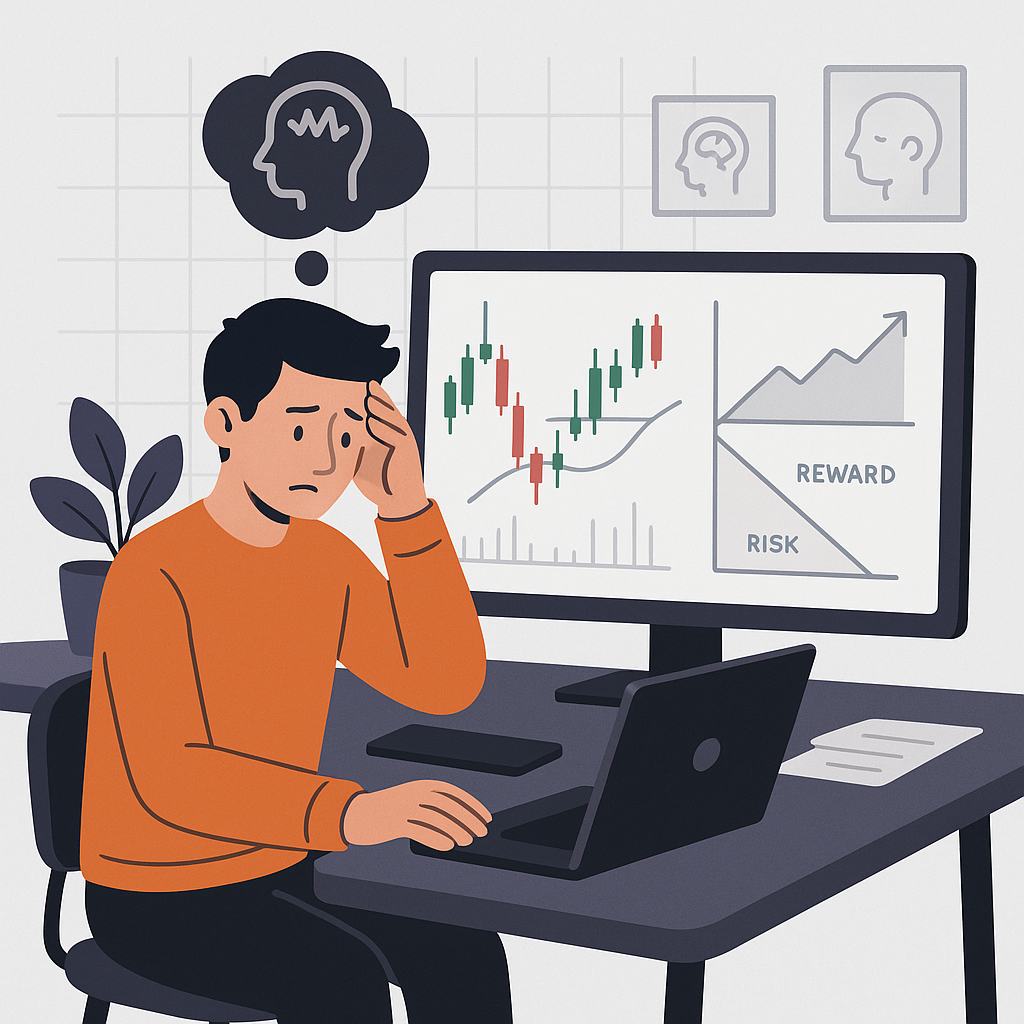
Scenario walkthrough #3: Doubling down after a loss (revenge trading)
Then, revenge trading is an attempt to end discomfort quickly. For example, you lose -1R and immediately take a low-quality setup at 2× size.
Circuit-breaker protocol:
You stop after your max-loss or consecutive-loss rule.
You do a short reset (walk + breathing).
You switch to sim or journaling only.
Mini case study: Oversized position → fear → early exits (fixed with 0.5R + brackets)
Finally, the most common fear spiral starts with size. For example, a trader risks $150 per trade, feels threatened, and sells winners at +0.2R repeatedly.
Fix applied:
Risk reduced to 0.5R of prior size for 20 trades.
Bracket orders used every entry.
Rule installed: partial only at TP1; trail after +1R.
Outcome (behavioral):
Fewer early exits.
Higher rule-adherence score.
Cleaner data to evaluate the edge.
Statistic — Source: Van Tharp, 2007: Position sizing and expectancy-based thinking are central to aligning psychology with system execution. https://www.vantharp.com
Image suggestion:
What’s next: your 7-day implementation plan
A 7-day plan to control fear in day trading is a short sprint that installs risk limits, checklists, and review habits before you try to increase size.
Day 1 — Set your risk numbers
Next, define: risk per trade, max daily loss, max trades/day. For example: 0.5% risk, -2R max loss, 3 trades max.
Day 2 — Build your A+ checklist
Then, write a one-page checklist and remove any vague items. For example, replace “good trend” with “price above VWAP and higher highs on 5m.”
Day 3 — Bracket orders only
Next, trade only if you can place a bracket instantly. For example, no bracket = no trade.
Day 4 — Install one in-trade management rule
Then, choose one simple rule: “Stop to breakeven at +1R, once.” Keep it fixed all day.
Day 5 — Journal rule adherence (not P&L)
Next, score each trade: Entry rules (0/1), Stop rules (0/1), Size rules (0/1). Your goal is 90%+ adherence.
Day 6 — Practice exposure in the simulator
Then, simulate your most fear-triggering window. For example, trade the open with half speed and focus on clean execution.
Day 7 — Review + adjust one variable only
Finally, review your journal for the biggest trigger. For example, if most errors happen after the first loss, tighten your consecutive-loss stop.
Conclusion
How to control fear in day trading is a process of defining risk before entry, limiting decisions during the trade, and reviewing execution after the trade.
Ultimately, fear doesn’t disappear because you “feel confident.” It shrinks because your rules make outcomes tolerable and repeatable. If you install position sizing, bracket orders, and circuit breakers this week, you’ll trade with more calm and consistency—one decision at a time.
FAQ: How to control fear in day trading
Fear in day trading is an emotion-driven threat response that disrupts execution, while caution is a rational risk check that follows your plan.
What is fear in day trading, and how is it different from caution?
Fear in day trading is an emotion-driven urge to avoid discomfort, while caution is a rational risk assessment that still follows your rules. For example, caution reduces size due to volatility, while fear moves a stop or skips an A+ setup without a plan-based reason.
Why does fear of losing cause traders to break their rules?
Fear of losing causes rule-breaking because your brain prioritizes short-term emotional relief over long-term expectancy. For example, widening a stop reduces anxiety in the moment, but it breaks your risk model and creates larger losses that reinforce fear later.
How do you know if your position size is causing your trading anxiety?
Your position size is causing anxiety if small fluctuations trigger physical stress or impulsive actions. For example, if -0.3R makes you want to exit early, reduce risk until you can hold to your planned stop and take the next trade normally.
What are the best day trading anxiety management techniques during a live trade?
The best live techniques are slow breathing, attention control, and decision-limiting rules. For example, use 4-in/6-out breathing, hide P&L, manage only at preplanned levels, and allow only one adjustment like stop-to-breakeven at +1R.
How can a max daily loss and max trades-per-day rule reduce emotional trading?
A max daily loss and trade limit reduce emotional trading by stopping escalation and decision fatigue. For example, ending the session at -3R prevents revenge trades, while a three-trade limit forces selectivity and reduces impulsive “make it back” behavior.
What should a pre-trade checklist include to prevent hesitation and FOMO?
A pre-trade checklist should confirm setup validity, risk, volatility, and session rules. For example, include setup name, entry/stop/target, R:R minimum, size calculation, news check, and max-loss status to turn entries into yes/no decisions.
How do you rebuild confidence after a big loss or drawdown?
You rebuild confidence after a drawdown by reducing size, tightening rules, and collecting clean execution data. For example, trade half-size for 20 trades using bracket orders only, then review rule adherence to prove you can execute consistently again.
When is it smarter to stop trading for the day due to fear or tilt?
It’s smarter to stop trading when you hit predefined circuit breakers or feel compelled to break rules. For example, stop after max daily loss, after two off-plan trades, or when you notice urges to oversize, widen stops, or “win it back” immediately.
Diagnose Your #1 Trading Mistake — Free
Answer 10 diagnostic questions and instantly find out which trading mistake is costing you the most — with a personalised 3-page correction plan PDF.
- Identifies your primary trading mistake
- Personalised 4-step correction plan
- 3-page PDF emailed to you free
What you'll discover:
-
Revenge Trading
Are you chasing losses?
-
Overtrading
Too many trades per day?
-
Emotional Trading
Feelings overriding logic?
Free. No sign-up required. PDF sent to your email.